ระบบนิเวศการฝึกอบรมแบบโมดูลาร์ที่พร้อมรับการรับรอง จะช่วยยกระดับทีมงานโรงแรม ร้านอาหาร คาเฟ่ และบาร์ทุกระดับให้กลายเป็นผู้เชี่ยวชาญด้านเครื่องดื่มที่สร้างรายได้ โปรแกรมฝึกอบรม HORECA มอบการศึกษาด้านเครื่องดื่มในสถานที่จริงที่มีประสิทธิภาพสูง ซึ่ง เปลี่ยนทุกจุดสัมผัสของพนักงานให้กลายเป็นผลกำไร ตั้งแต่การสปรินต์สาเกหนึ่งวันไปจนถึงการลงลึกกับซอมเมลิเยร์ห้าวัน ผู้สอนระดับปรมาจารย์ของเราประจำกรุงเทพฯ มาพร้อมกับประสบการณ์ที่คัดสรรมาอย่างดี ห้องปฏิบัติการบริการแบบปฏิบัติจริง และการวิเคราะห์แบบเรียลไทม์ ช่วยเพิ่มระดับความพึงพอใจของลูกค้าและความพึงพอใจของลูกค้าได้อย่างวัดผลได้
Most wine training fails in the same place. Staff learn grape varieties in a classroom, return to the floor, and still cannot answer a guest who asks which white goes with the fish, or why the bottle they ordered is being decanted. Knowledge without service sequence does not reach the guest, and service sequence without knowledge collapses the moment a guest asks a follow-up question.
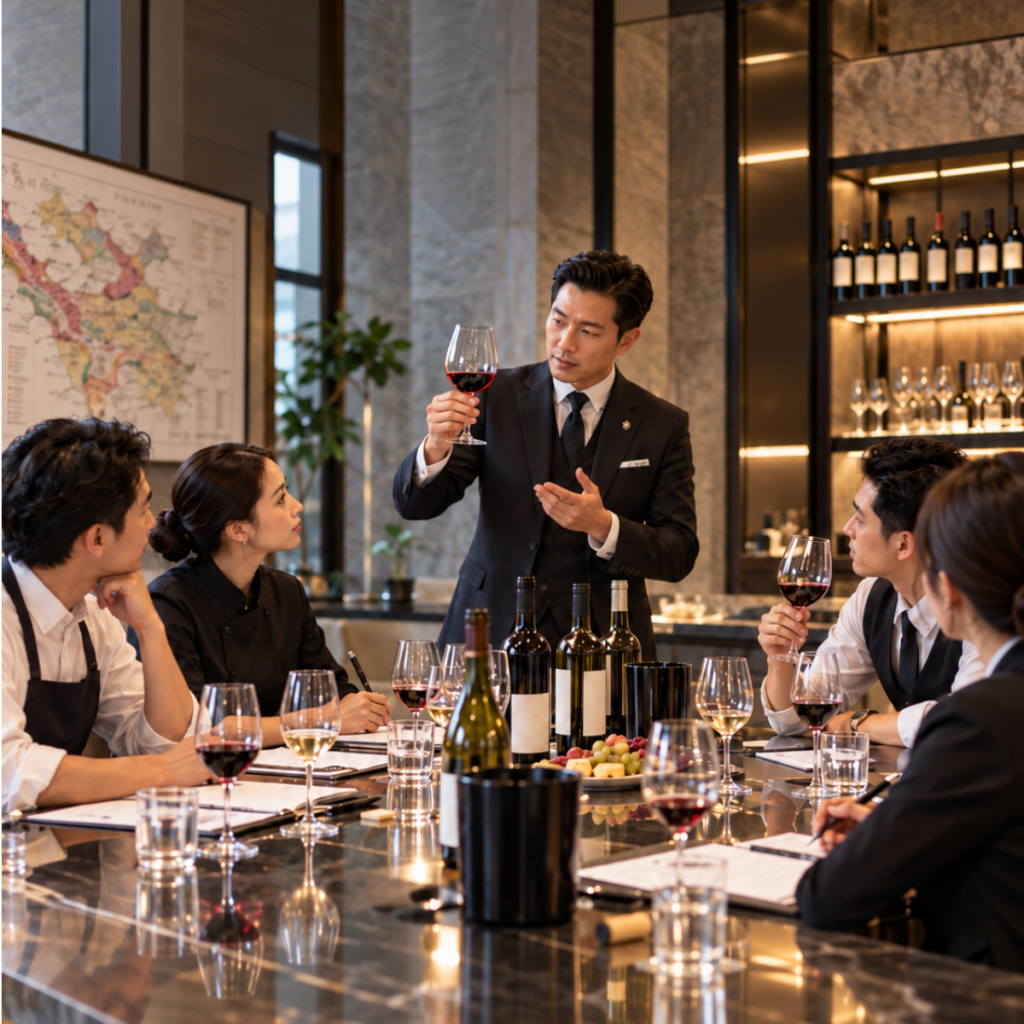
HORECA training teaches both in the same session, at your venue, on the glassware your team actually uses, in the room where they actually work. Your team hears the glass, handles the bottle and runs the service in front of an instructor who has done it in Michelin-starred rooms.
Wine lists in Thailand are getting more expensive to get wrong. The value of imported bottled wine into Thailand grew 6.24% in 2025 to THB 3.72 billion (Asia Wine Ratings, April 2026), which means the average bottle on your list carries more margin and more risk than it did two years ago.
Staff default to lowest-priced pours rather than recommending pairings that double check value because they fear mispronouncing labels or giving faulty advice.
Over-chilled premium reds and warm whites lead to returned bottles, damaged corks, and guest friction that degrades restaurant prestige.
Live service simulations on your floor transform hesitant service into authoritative 15–28% upselling in average bottle returns and repeat guest retention.
Every program adapts to your live bottle list, glass inventory, and dining room service sequences.
| Program | Price | Core Focus | Best Suited For |
|---|---|---|---|
| HORECA Wine Etiquette & Pairings | ฿28,000 | Etiquette, glassware, service order, pairing principles | New floor staff, cafés and restaurants adding a wine list |
| HORECA Foundation of Sommelier Skills Basic | ฿39,000 | Structured tasting method, major varieties, regions, service standards | Restaurants and hotels wanting a consistent baseline across the team |
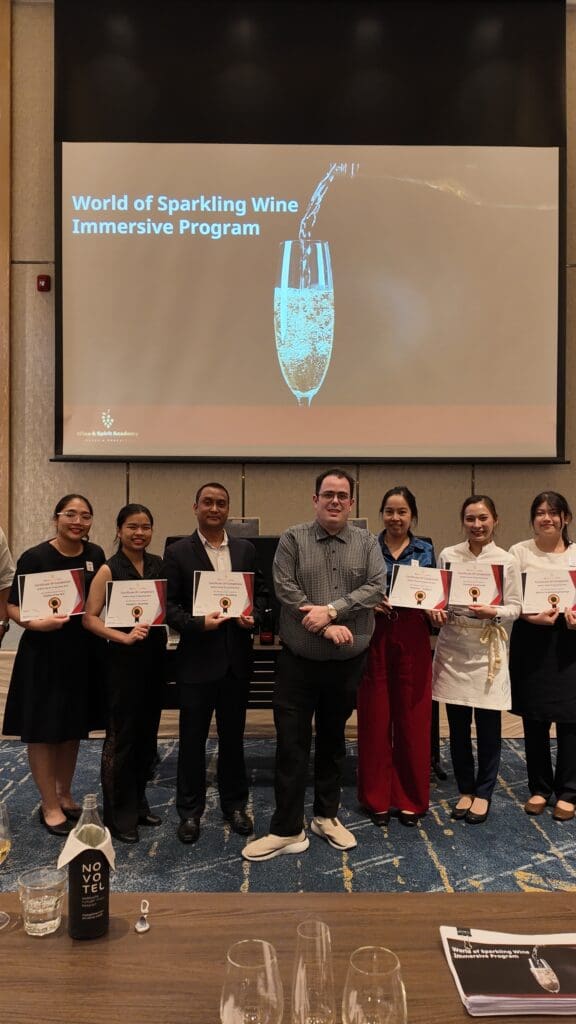
| HORECA Sparkling Wine Immersive Program | ฿44,000 | Champagne & sparkling styles, opening & pouring, celebration service | Venues selling sparkling by the glass, hotels with event business |
The entry program, and the one most restaurants start with. Staff learn the order of service, how to present and open a bottle, which glass goes with what, and the pairing logic they need to make a recommendation instead of a guess. It is the fastest route to a floor team that no longer avoids the wine section of the menu.
The same ground as our FSS Basic level, adapted for a working venue. A repeatable tasting method, the major grape varieties and regions, and service standards taught as a sequence rather than a list. Use this when you need every server saying the same thing about the same bottle.
Champagne and sparkling wine from production through style, then the practical side: opening without noise or spillage, pouring a flight, keeping the bottle cold through a service, and handling the celebration table. Hotels with banquet business and venues selling sparkling by the glass get the most from this one.
Session length & staffing advisory: Structured for cohorts of up to 10–12 staff per session, delivered either in a focused 1-day immersive block (6 hours) or split across two consecutive morning shifts (3 hours × 2) to ensure seamless floor operations without service disruption.
Five sequential milestones from diagnostics to written accountability reports.
We look at your wine list, your menu, and where the team currently loses money: bottles returned, questions deflected, glasses poured without a recommendation. Built around gaps, not a generic syllabus.
Tasting, with the instructor leading the method line by line. Staff taste the styles they will actually sell, not an abstract tour of the world.
Staff run the sequence in pairs: presenting, opening, decanting, pouring, answering a guest question while doing it. The instructor corrects on the spot, where true learning happens.
A short practical and tasting check, so you know who can do it and who needs a second pass. Names go into a short report for your F&B manager.
A written summary with the gaps we found, the standards set, and a short refresher plan your supervisors can run themselves internally.
A trained team recommends a bottle instead of describing it, and recommends the second bottle more often than the first. They decant without hesitating, pour the correct glass without being asked, and handle a guest who knows more than they do without panic.
Staff confidently pivot guests from the entry pour to mid-tier artisanal producers by explaining terroir narratives naturally.
Guests who ask for beer or water with entrées are offered pairing glasses, multiplying per-cover wine turnover across services.
Trained cellar temperature control and proactive cork inspection drastically slash costly wasted inventory and guest disputes.
Front staff handle vintage shifts and acidity questions independently, freeing floor managers to focus on dining room pacing.
The 4-Week Floor Audit Protocol: Track these four metrics for four weeks before and four weeks after training, and you will see whether the training worked in your venue rather than trusting a supplier's case study.
The three programs are ฿28,000, ฿39,000 and ฿44,000. What moves the number is the number of staff trained, how many sessions it takes to cover them, the wine tier used in the tasting, whether we come to one venue or several, and how far the venue sits from central Bangkok.
The master instructor, benchmark wines tasted, sensory aids, and all session training materials.
Custom travel outside Bangkok, multi-property rollouts, and periodic quarterly refresher cycles.
Training runs at your venue and needs a room that can seat the group with tables, water, and a service area for practical work. Sessions can run before service, on a closed day, or split across two mornings for teams that cannot all leave the floor at once.
Best months are outside the December and January peak, when your team is busiest and least able to sit still for a session. New hotel openings usually book four to six weeks ahead of the training date.
“The Essential Wine & Spirit Service class helped me train my restaurant staff. Their upselling and wine recommendations have improved overnight.”
“I took the Foundation of Sommelier Skills class and it was brilliant! We tasted 10 different wines, and the depth of knowledge from the instructor was unmatched.”
At your venue. The instructor brings the wines and runs the session in your room, on your equipment, because the point is to change what happens on your floor.
Standard cohorts are sized for 6 to 12 participants per instructor to ensure intensive hands-on roleplay, individualized pouring correction, and meaningful tasting feedback. Larger teams can be split across consecutive sessions.
Either, or a mix. Most Bangkok venues with mixed teams run the session in Thai with English terminology, since that is how the floor actually speaks.
Yes, all attendees who successfully complete the hands-on service sequence and tasting evaluation receive an official Wine & Spirit Academy Bangkok Certificate of HORECA Competency.
Absolutely. While WSA provides benchmark flights, we strongly recommend integrating 2–3 bottles from your live inventory to drill precise upselling points and guest objections on your current menu.
Tell us the venue, the headcount and the date you want, and we will confirm availability. Peak season dates go first. New venues typically schedule 2–4 weeks in advance.
Yes. The Wine Etiquette & Pairings program assumes no prior knowledge and is where most restaurants start.
Send your venue type, the number of staff to train, and the month you want the session to 099-016-8838 (Monday to Friday, 9:00 to 20:00) or Line at @028fukzk. You will get a recommended program, a fixed price and a session outline built on your list, not a brochure.
Images from our Wine & Spirit Tours, Classes & Training