You are standing in a wine shop or scrolling a restaurant wine list. There are dozens of bottles in front of you. Some have a grape variety printed in large letters. Others show only a château name and a region you have never heard of. A few look completely mysterious — nothing but a foreign word and a year.
You pick one up. The label tells you nothing you understand.
This moment is familiar to almost every wine beginner — and it is entirely unnecessary. Once you know what each element on a wine label means, a bottle stops being intimidating and starts being readable. In ten minutes, you will be able to decode any wine label in the world.
At Wine & Spirit Academy Bangkok, teaching people to read wine is one of the first things we do in every course. This guide covers everything our students learn in that first session.
The short answer is that there is no single global standard for wine labels. A bottle from France might lead with the region. A bottle from Australia might lead with the grape variety. A bottle from Germany might show a classification system that dates back to the 19th century. Each wine-producing country developed its own labelling traditions before any international standards existed, and those traditions persist today.
Once you understand the logic behind each country’s approach, everything becomes clearer. But first, let’s cover the elements that appear on almost every wine label in the world.
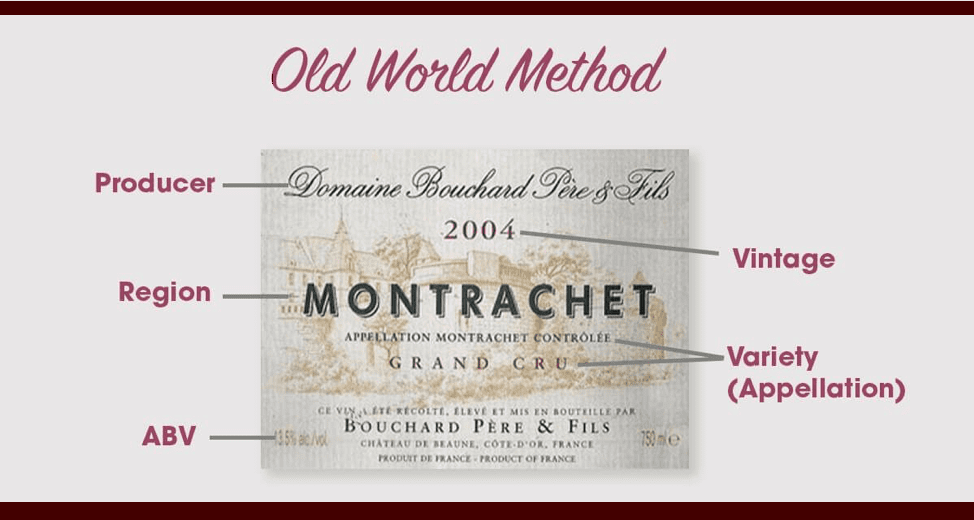
1.The Producer or Estate Name
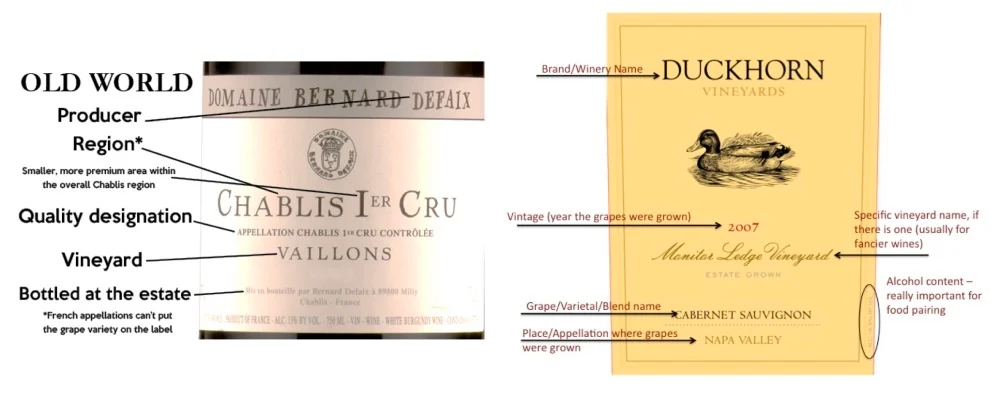
This is the name of the winery, château, domaine, or producer who made the wine. It can be a family name, a place name, or a brand name. Examples: Château Margaux, Robert Mondavi, Cloudy Bay.
In France and Italy, the producer name is often less prominent than the region or classification. In the New World — Australia, New Zealand, Chile, Argentina — the producer name is usually the most visible element on the front label.
2. The Region or Appellation
This tells you where the grapes were grown. It can be as broad as a country (“Vin de France”) or as specific as a single village (“Pommard”, “Barolo”, “Gevrey-Chambertin”).
In the Old World (France, Italy, Spain, Germany), the region is often the most important information on the label — because in European wine culture, where grapes are grown largely determines what they taste like. The idea that specific plots of land produce specific flavours is called terroir, and it is the foundation of European wine classification.
In the New World, the region matters but the grape variety often takes priority. You will see “Marlborough Sauvignon Blanc” where Marlborough (the region) supports the grape name rather than replacing it.
3. The Grape Variety (or Varieties)
This tells you which grape was used to make the wine. Some bottles state this clearly: “Chardonnay”, “Cabernet Sauvignon”, “Riesling”. These are called varietal wines.
However, many European wines do not state the grape at all. A bottle labelled “Chablis” is always made from Chardonnay — but the label will not tell you this. A bottle labelled “Barolo” is always made from Nebbiolo. A bottle labelled “Sancerre” is always Sauvignon Blanc. In Europe, the assumption is that if you know the appellation, you know the grape.
This is one of the main reasons European wines confuse beginners. The solution: learn the major European appellations and the grapes they correspond to. Our FSS Sommelier Classes at WSA cover this systematically.
4. The Vintage
The vintage is the year the grapes were harvested. You will see it as a four-digit year — 2019, 2021, 2023.
Why does the vintage matter? Because weather varies from year to year, and weather profoundly affects how grapes ripen. A warm, dry year typically produces riper, fuller-bodied wines. A cool, rainy year may produce leaner, more acidic wines — which in some regions is actually considered superior. In Burgundy, for example, great vintages are discussed with the same reverence reserved for great harvests in a wheat field.
For most wines sold in Thailand, the vintage is a useful indicator of freshness rather than a deep quality signal. Look for vintages within 3–5 years for white wines and light reds, and up to 10–15 years for structured red wines like Bordeaux, Barolo, or Rioja.
Non-vintage wines (labelled NV) are blended from multiple years to achieve a consistent house style. This is standard practice in Champagne and many fortified wines.
5. The Classification or Quality Level
Many wine regions have official quality classification systems. These appear on the label and tell you where the wine sits within the regional hierarchy.
The most important classifications to know:
France:
Burgundy specifically:
Bordeaux:
Italy:
Germany:
6. The Alcohol by Volume (ABV)
Required by law on all wine labels. Expressed as a percentage: 12%, 13.5%, 14.5%.
ABV is a useful proxy for wine style:
As we discussed in our Thai food pairing guide, ABV is particularly relevant when selecting wine for spicy cuisine — the higher the alcohol, the more it amplifies heat.
7. The Volume
Standard bottle: 750ml. Also common: 375ml (half bottle), 1.5L (magnum), 3L (double magnum). Larger formats age more slowly because the ratio of wine to oxygen through the cork is lower.
8. Sulphites Declaration
Most wine labels in countries requiring it (EU, Australia, USA) will state “Contains Sulphites” or “Contains Sulfites.” Sulphur dioxide (SO₂) is used as a preservative in winemaking and has been since ancient times. The declaration is legally required above a certain threshold (10mg/L in the EU). Natural wines often contain lower levels but are not automatically sulphite-free.
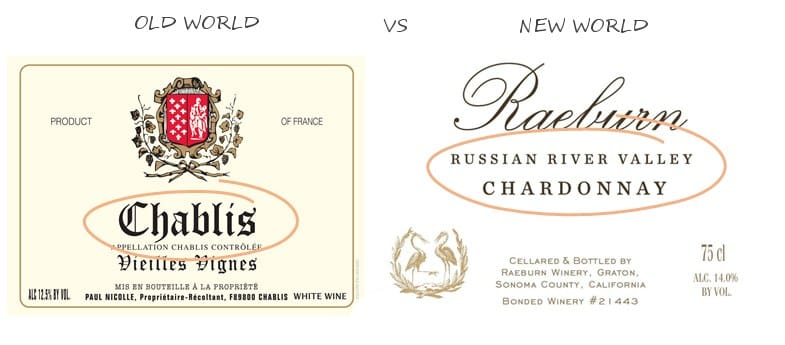
Understanding this distinction saves a great deal of confusion.
Old World Label Logic (France, Italy, Spain, Germany, Austria)
Old World labels prioritise place over grape. The assumption is: if you know the place, you know the grape and the style. Labels tend to show the region or appellation prominently, the producer name, the classification, and the vintage. The grape variety is often absent entirely.
Example: A bottle labelled “Pouilly-Fumé 2022, Domaine Didier Dagueneau, AOC Pouilly-Fumé” tells you: region (Pouilly-Fumé, Loire Valley), producer (Dagueneau), quality level (AOC), vintage (2022). The grape — Sauvignon Blanc — is not stated but implied.
New World Label Logic (Australia, New Zealand, USA, Chile, Argentina, South Africa)
New World labels prioritise grape variety over place. The grape name is usually the most prominent element, followed by the producer and the region. Classifications are rare or informal.
Example: “Cloudy Bay Sauvignon Blanc 2023, Marlborough, New Zealand” tells you immediately: grape (Sauvignon Blanc), producer (Cloudy Bay), vintage (2023), region (Marlborough), country (New Zealand). Nothing is hidden.
New World labels are generally easier for beginners — which is one reason New World wines tend to outsell European wines in Asian markets.
The back label is where producers add information they could not fit on the front — or information they want to communicate more directly to consumers.
Look for:
French labels are the most complex and the most rewarding to learn, because France produces more classified wine regions than any other country.
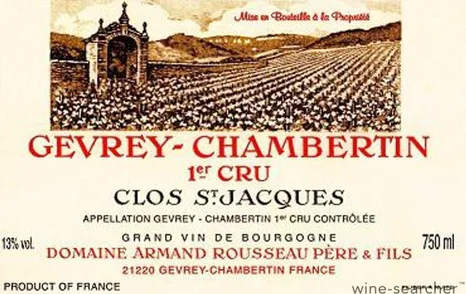
Reading a Burgundy label:
“Gevrey-Chambertin Premier Cru Clos Saint-Jacques 2019, Domaine Armand Rousseau, Côte de Nuits, Bourgogne”
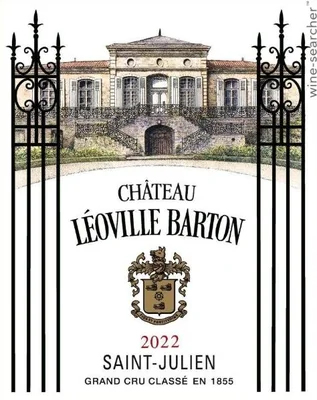
Reading a Bordeaux label:
“Château Léoville-Barton 2018, Saint-Julien, Deuxième Grand Cru Classé en 1855”
German labels are uniquely detailed — and uniquely intimidating. They contain more information than any other country’s labels, which paradoxically makes them harder to read at first glance.
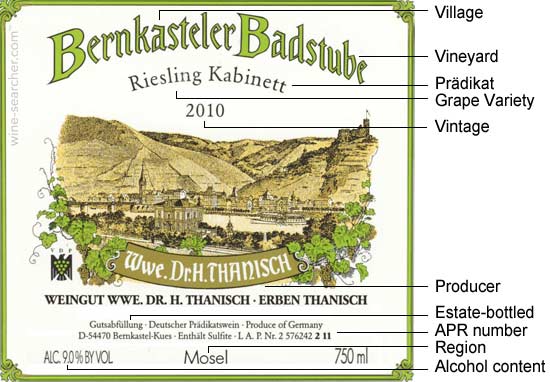
Key elements:
| Term | Meaning |
|---|---|
| Château | Estate/winery (France, especially Bordeaux) |
| Domaine | Estate (France, especially Burgundy) |
| Cru | Growth or classified vineyard |
| Clos | Walled vineyard (Burgundy) |
| Weingut | Winery (Germany, Austria) |
| Cantina / Azienda | Winery (Italy) |
| Bodega | Winery (Spain) |
| Reserva / Gran Reserva | Minimum ageing requirement (Spain) |
| Riserva | Extended ageing (Italy) |
| Trocken | Dry (Germany) |
| Sec / Brut | Dry (France, sparkling) |
| Doux / Demi-sec | Sweet / half-dry (France) |
| Vieilles Vignes | Old vines — generally more concentrated wine |
| Mis en bouteille au château | Estate-bottled (French) |
| Sur lie | Aged on lees (adds creaminess and texture) |
| NV | Non-vintage — blended from multiple years |
1. Assuming a higher price means a better label
An expensive wine does not always have a more informative label. Some of the world’s most prestigious wines (DRC, Pétrus, Screaming Eagle) have remarkably minimal labels. Price and label complexity are unrelated.
2. Confusing the region for the grape
“Burgundy” is not a grape. “Champagne” is not a grape. “Rioja” is not a grape. These are places. The grapes associated with them (Pinot Noir/Chardonnay, Chardonnay/Pinot Noir/Pinot Meunier, Tempranillo) must be learned separately.
3. Ignoring the back label
Many beginners focus entirely on the front label. The back label often contains the most practical information — serving temperature, food pairing suggestions, and winemaking details.
4. Assuming “Reserve” always means something
In the New World, the word “Reserve” on a label has no legal meaning in most countries. Any producer can call any wine a “Reserve.” In Spain and Italy, however, “Reserva” and “Riserva” are legally defined terms with minimum ageing requirements.
5. Overlooking the alcohol percentage
As we covered in our Thai food pairing guide, ABV has real practical implications for how a wine will behave with food — especially spicy food. Always check it.
The best way to learn wine labels is to read them actively every time you open a bottle. Keep a simple wine journal — even a notes app on your phone — where you photograph each label and write two or three words about what the wine tasted like.
Within six months of doing this consistently, you will have built a personal reference library of producers, regions, and vintages that means something to you rather than abstract information memorised from a book.
If you want to accelerate this process significantly, our Wine Classes at WSA Bangkok give you a structured path from label confusion to genuine confidence, covering all major wine regions with practical tasting in every session.
Reading a label is the first step. Understanding why a wine from a specific village in a specific vintage from a specific producer tastes the way it does — and why it pairs with certain foods but not others — is the journey that follows.
At Wine & Spirit Academy Bangkok, we offer courses at every level:
→ Browse All Wine Courses (link to /services/wine-classes/)
→ FSS Sommelier Programme (link to /services/fss-sommelier-classes/)
→ Contact Us (link to /contact/)
What is the most important thing on a wine label?
For beginners, the grape variety and the vintage are the most immediately useful pieces of information. The grape tells you the basic style to expect. The vintage tells you how old the wine is and gives context about the growing season. Everything else builds on top of these two foundations.
Why do some wine labels not show the grape variety?
European wines — particularly French, Italian, and Spanish — often omit the grape because the traditional assumption is that the appellation (region) already tells an informed drinker what grape was used. Chablis is always Chardonnay. Barolo is always Nebbiolo. Rioja Tinto is always Tempranillo-dominant. Learning the major European appellation-to-grape correspondences is a core part of any serious wine education.
What does “Grand Cru” mean on a wine label?
It depends on the country and region. In Burgundy, Grand Cru is the highest classification, applied to a small number of specific vineyards — only about 33 vineyards carry this designation. In Bordeaux, “Grand Cru Classé” refers to the 1855 classification of châteaux (not vineyards). In Alsace and Champagne, Grand Cru also exists but with different criteria. Always read Grand Cru in context of its specific region.
What does “old vines” or “Vieilles Vignes” mean?
It indicates that the wine was made from old grapevines, typically defined as over 30–40 years old, though there is no legal minimum age. Older vines generally produce lower yields but more concentrated, complex fruit. You will see this on French, Spanish, and South African labels particularly often.
Is a higher ABV always a worse wine?
No. Higher alcohol simply reflects riper grapes grown in warmer climates or longer growing seasons. A 15% Châteauneuf-du-Pape is not inferior to a 12% Mosel Riesling — they are different styles for different occasions. The practical consideration is matching ABV to food: lower alcohol wines work better with delicate dishes and spicy cuisine, while higher alcohol wines suit rich, fatty foods.
Article by Anthony Caradec, Founder of Wine & Spirit Academy Bangkok — certified wine and spirits professional with over 18 years of experience across Europe and Southeast Asia.
The Michelin Grappes are the newest award from the Michelin

You have a team to reward, a client to impress,
Most people drink wine. Very few people actually taste it.