Wine can feel complicated before it feels enjoyable.
There are grape varieties, regions, labels, vintages, serving temperatures, glassware, tasting notes, and food pairing rules. Sake can feel even more unfamiliar, with terms like junmai, ginjo, rice polishing ratio, koji, and serving style.
But here is the good news: you do not need to become a sommelier to enjoy wine or sake with more confidence.
At Wine & Spirit Academy Bangkok, we believe beverage education should feel practical, welcoming, and useful from the very first class. Whether you are ordering wine at dinner, pairing sake with Japanese cuisine, choosing a bottle as a gift, or building a hospitality career, the right foundation can completely change the way you experience what is in your glass.
Bangkok’s dining scene is more exciting than ever. Thai restaurants, omakase counters, wine bars, hotel lounges, bistros, and tasting menus have made premium beverages part of everyday conversation.
That also means more people are asking practical questions:
These are not “beginner questions.” They are the questions that lead to real understanding.
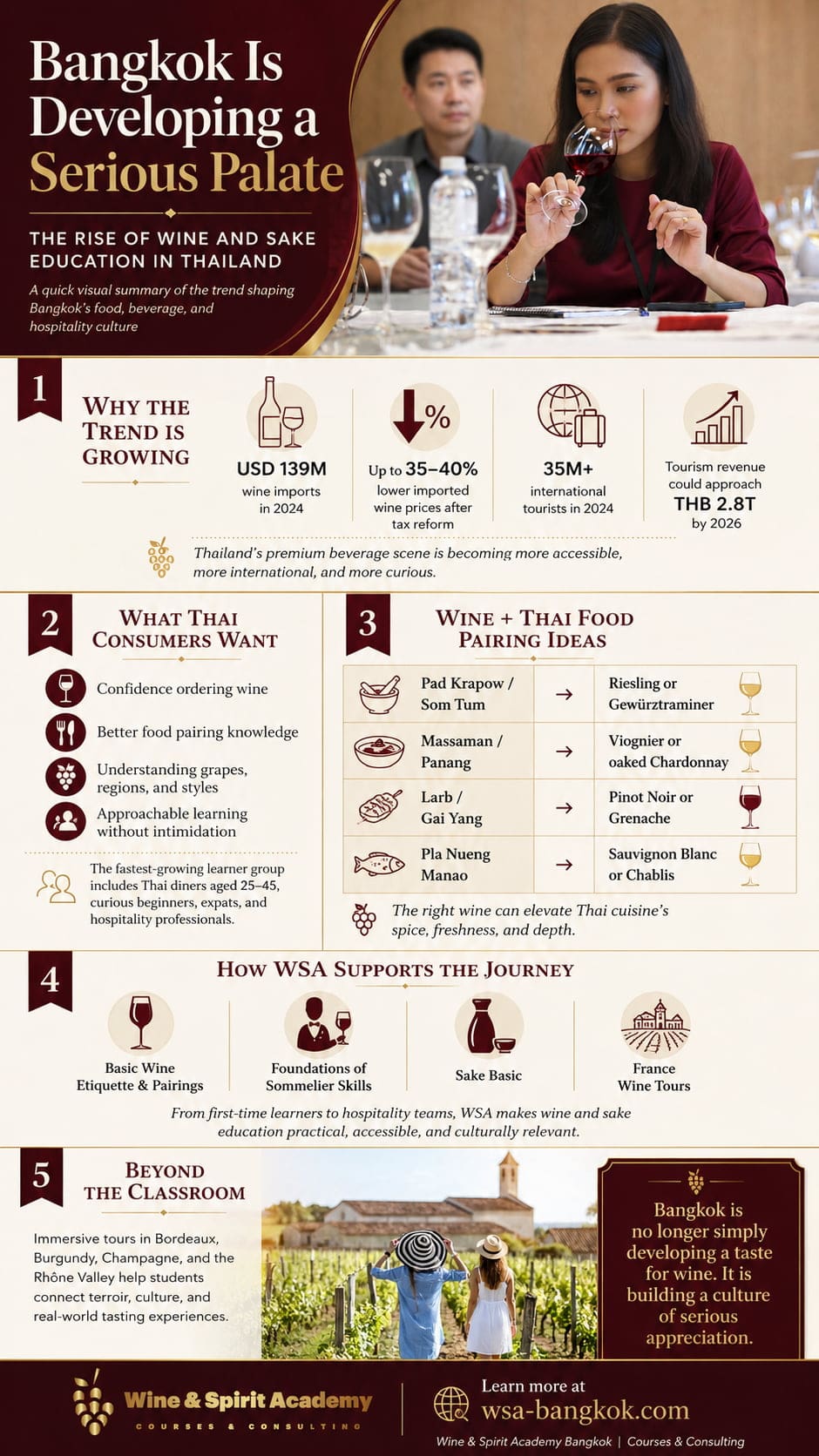
The infographic below gives a quick look at why wine and sake education is growing in Thailand, from tourism and hospitality trends to Thai food pairings and immersive wine travel.
Many people think wine education begins with memorising famous regions. At WSA, we believe it begins with taste.
A glass of Riesling makes more sense when you try it with something spicy. A Pinot Noir becomes easier to understand when you pair it with grilled meat. A crisp Sauvignon Blanc feels more memorable when you taste it beside seafood with lime, herbs, and chilli.
This is especially important in Thailand, where food is naturally complex.
Thai cuisine often combines:
| Thai Flavour Element | Why It Matters for Pairing |
|---|---|
| Chilli heat | Needs freshness, fruit, acidity, or gentle sweetness |
| Lime and tamarind | Work well with bright, crisp wines |
| Coconut milk | Benefits from fuller-bodied whites |
| Fish sauce and umami | Can pair beautifully with sake and textured whites |
| Fresh herbs | Match aromatic wines and clean sake styles |
When students learn through dishes they already know and love, wine becomes less abstract. It becomes useful.
Bangkok has a deep connection with Japanese dining culture, but sake is still often misunderstood.
Some people think sake is always strong. Others assume it should always be served hot. Many diners are unsure how to choose between different sake styles on a menu.
In reality, sake is one of the most versatile beverages for food pairing. It can be delicate, floral, savoury, creamy, dry, fruity, earthy, or umami-rich depending on the style and production method.
A good sake class helps students understand:
For hospitality professionals, this knowledge can improve guest experience immediately. For enthusiasts, it opens the door to a completely new way of enjoying food and drink.
Most students do not come to WSA because they want to sound impressive. They come because they want to feel more confident.
Confidence means knowing what to order when a wine list feels overwhelming.
It means choosing a bottle for dinner without guessing.
It means explaining a sake recommendation to a guest clearly and naturally.
It means understanding why you like something, not just whether you like it.
That is why our courses focus on practical learning, guided tasting, food pairing, service, and conversation. We remove the pressure and replace it with structure, clarity, and real-world examples.
For students who want to go deeper, wine education can also become a travel experience.
Visiting wine regions such as Bordeaux, Burgundy, Champagne, or the Rhône Valley gives learners a direct connection to terroir, tradition, climate, soil, producers, and regional identity.
It is one thing to taste a wine in a classroom. It is another to stand in the vineyard where it began.
These experiences help students connect the glass to the people, places, and stories behind it.
You do not need previous wine knowledge to start. You only need curiosity.
For beginners, Basic Wine Etiquette & Pairings is a friendly starting point for learning how to taste, choose, and pair wine in everyday situations.
For hospitality professionals, Foundations of Sommelier Skills builds structured knowledge in tasting, service, food pairing, and professional beverage communication.
For Japanese food lovers and restaurant teams, Sake Basic introduces the essential language, styles, and serving principles of sake.
For travellers and enthusiasts, France Wine Tours bring wine education into the regions that shaped the world’s most iconic bottles.
Wine and sake education is not about memorising everything. It is about enjoying more, choosing better, and connecting more deeply with food, culture, travel, and hospitality.
Read the full Bangkok Post feature on Bangkok’s growing wine and sake education culture here:
https://www.bangkokpost.com/thailand/pr/3259750/bangkok-is-developing-a-serious-palate-the-rise-of-wine-and-sake-education-in-thailand
Explore WSA courses and consulting here:
https://wsa-bangkok.com/
Bangkok’s palate is growing. The best way to be part of it is to start tasting, asking questions, and learning one glass at a time.
Most people who say they find French wine intimidating are
On 8 September 2026, at the Cité du Vin in
The most complete certified wine program in Bangkok is the