
By Wine & Spirit Academy (WSA Bangkok)
The short answer: aromatic Junmai Ginjo for sour and citrus-driven dishes, Nigori for chili heat, robust Junmai for grilled and fermented dishes, and sparkling sake when you cannot decide. Serve everything colder than you think, and keep the Daiginjo away from the som tam.
Thai food is often described as difficult to pair. It is not — it is difficult to pair with wine. Chili, lime, fish sauce and palm sugar arriving on the palate at the same time will defeat most wines in the room. Sake is built differently, and in Bangkok we have the rare privilege of being able to test that claim at almost every meal.
This guide is drawn from what we pour and taste in our sake classes at Wine & Spirit Academy. It moves from the principles to twelve specific dishes, then to the part almost everyone gets wrong: temperature.
Three structural differences explain almost everything.
No tannin. Tannin and capsaicin are a bad combination. The drying, grippy sensation of tannin compounds the burn of chili, which is why a Cabernet Sauvignon with a green curry tastes bitter and hot rather than balanced. Sake has no tannin at all.
Low acidity. Most sake sits around 1.2 to 1.6 g/L in total acidity, roughly a quarter of a typical white wine. Thai cooking brings its own acidity in abundance — lime, tamarind, green mango, pickled greens. A low-acid drink lets that acidity read as freshness rather than as a fight.
High amino acid content. Sake contains many times more amino acids than wine, glutamic acid in particular. Fish sauce, shrimp paste and fermented ingredients are glutamate-rich too. Put them together and the umami does not cancel out — it multiplies. This is the single most underused pairing lever in Thai cuisine.
If you want the full technical comparison, we cover it in depth in our guide to sake vs wine.
Rather than memorising a hundred pairings, learn four. Almost every Thai dish leans on one of these axes, and each axis has a sake style that answers it.
| Flavor axis | Typical dishes | Sake style | Serving temperature |
|---|---|---|---|
| Chili heat (phet) | Green curry, gaeng ped, phad kaphrao | Nigori, or a soft off-dry Junmai | Well chilled, 5–8 °C |
| Sour and citrus (priao) | Tom yum, som tam, yum salads | Junmai Ginjo, aromatic and fruity | Chilled, 10–12 °C |
| Fermented umami | Larb, nam prik, pla ra, dishes heavy on fish sauce | Junmai, Kimoto or Yamahai | Room temperature to warm, 20–40 °C |
| Sweet and rich (coconut, palm sugar) | Massaman, khao soi, mango sticky rice | Sparkling sake, Nigori, or aged Koshu | Chilled, 8–10 °C |
Two mechanisms are at work across all four. Affinity matches like with like: the toasted rice powder in larb against the rice character of a Junmai. Contrast sets one against the other: the residual sweetness and creamy texture of a Nigori against chili heat. Neither is superior. Knowing which one you are using is what makes a pairing repeatable rather than lucky.
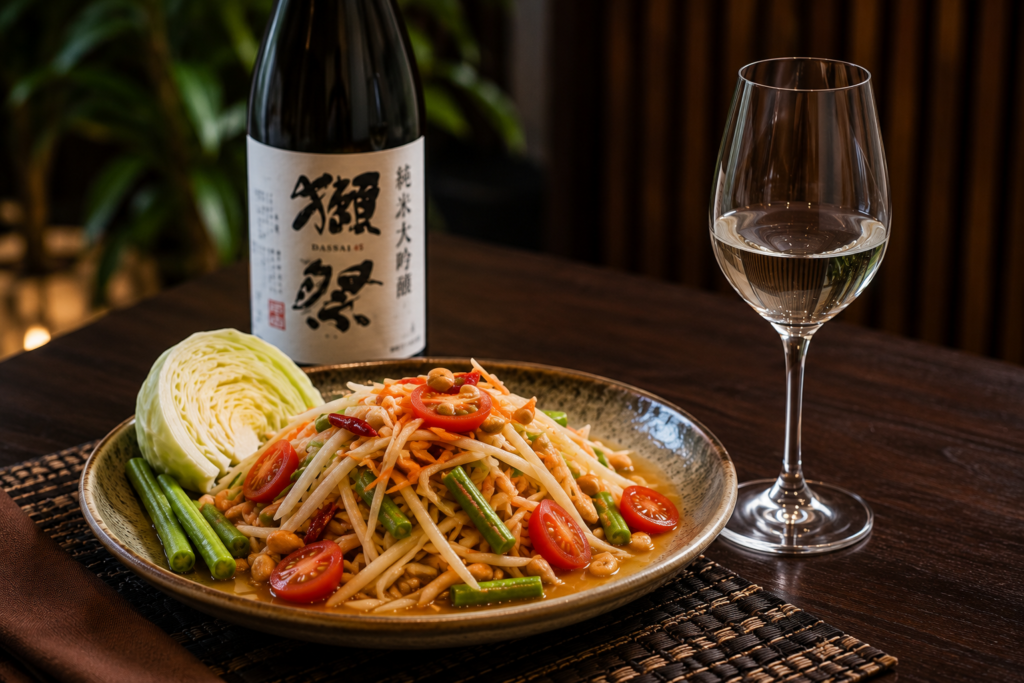
Lime, palm sugar, fish sauce, dried shrimp, raw garlic and chili — four axes in one mortar. Pour: a fruity Junmai Ginjo with melon and pear aromatics, or a sparkling sake. Why: the ginjo esters echo the lime without adding acidity, and the residual sweetness handles the chili. Avoid: Daiginjo. Its delicacy is simply erased, and you have wasted your best bottle.
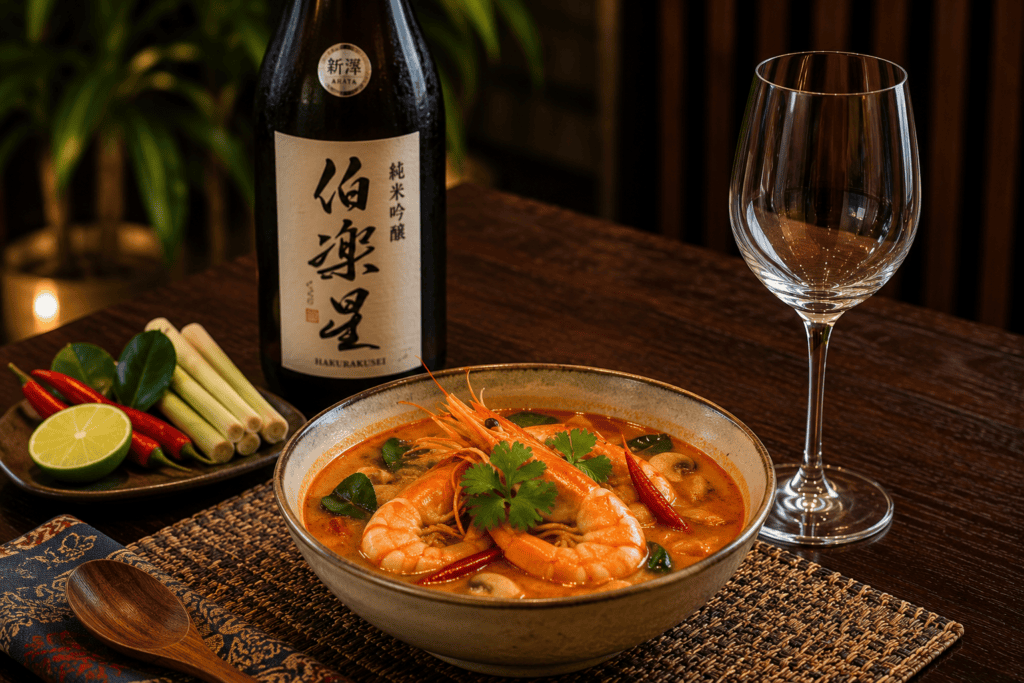
Lemongrass, galangal, kaffir lime leaf and chili in a sour broth. Pour: a herbaceous, citrus-inflected Junmai Ginjo, well chilled. Why: aromatic affinity — the sake’s citrus and green notes sit directly on top of the lemongrass and kaffir lime. Note: for the creamy nam khon version, switch to a Nigori; the added richness needs texture to meet it.
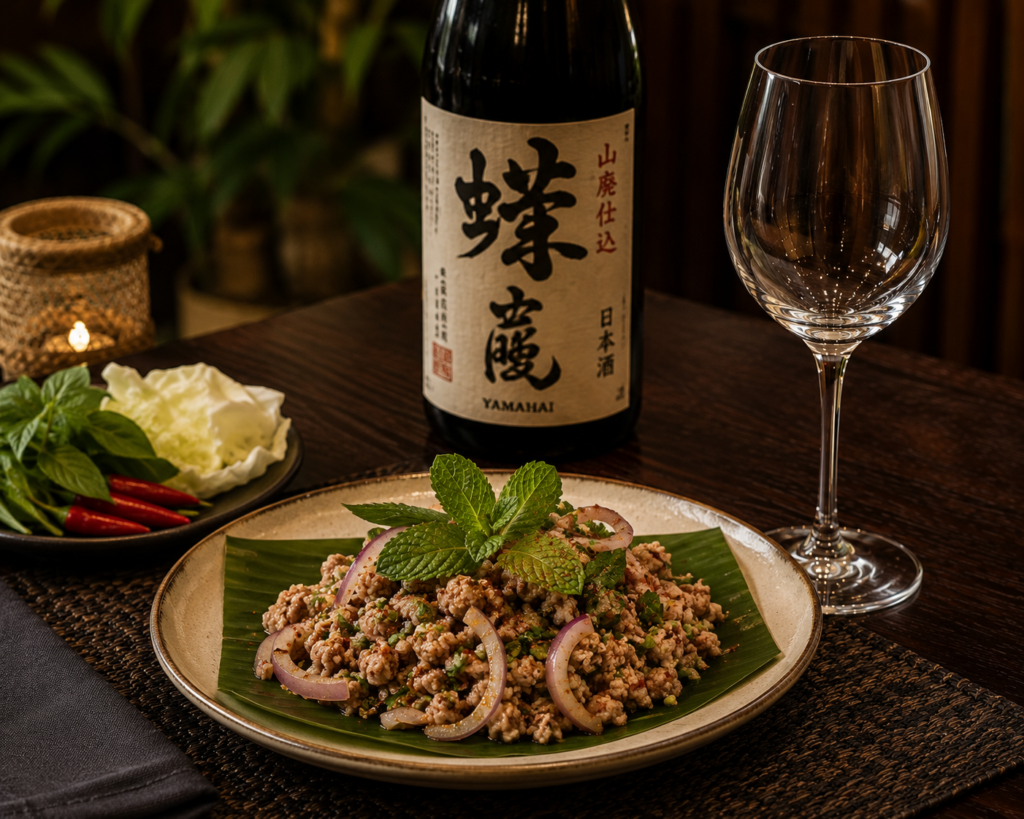
The dish that converts sceptics. Pour: a Kimoto or Yamahai Junmai, served at hitohada-kan, around 35 °C. Why: toasted rice powder (khao khua) against the nutty, lactic depth of a Yamahai is one of the great affinity pairings available in Thailand, and warming the sake pushes its umami forward to meet the fish sauce.
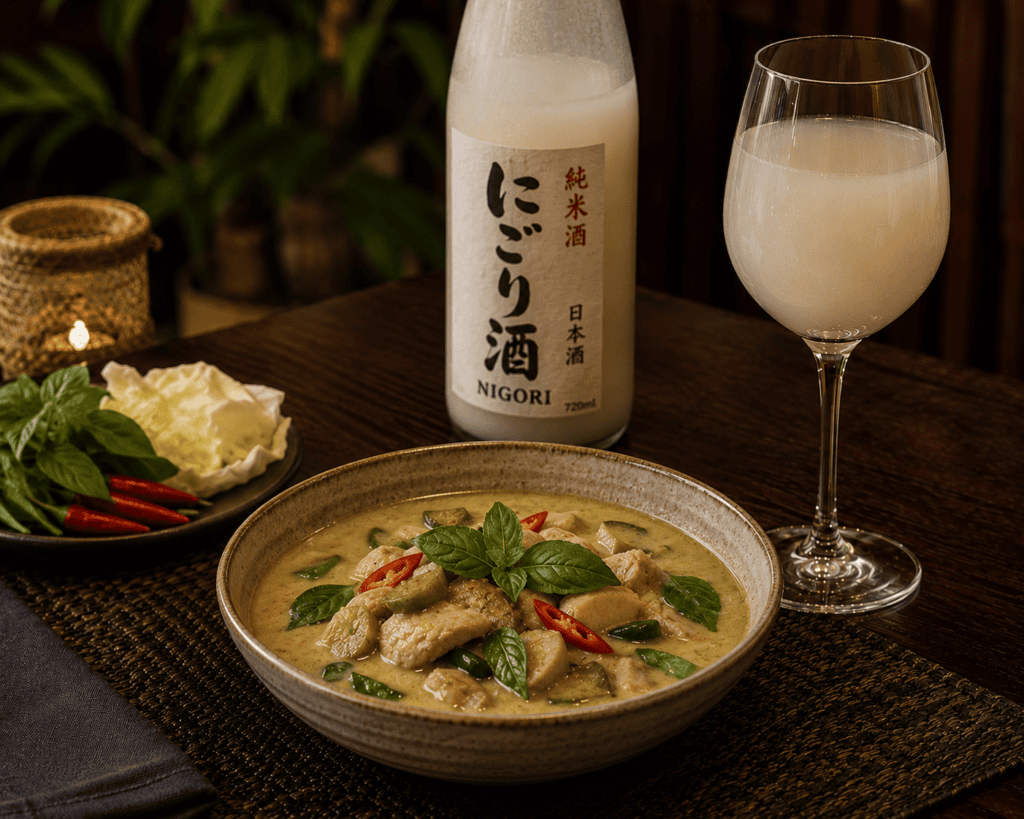
Coconut fat carrying green chili heat. Pour: Nigori, thoroughly chilled. Why: pure contrast plus textural affinity — the cloudy rice sediment mirrors the coconut milk while the sweetness cools the capsaicin. Avoid: anything warm. Warm sake amplifies chili heat rather than relieving it.
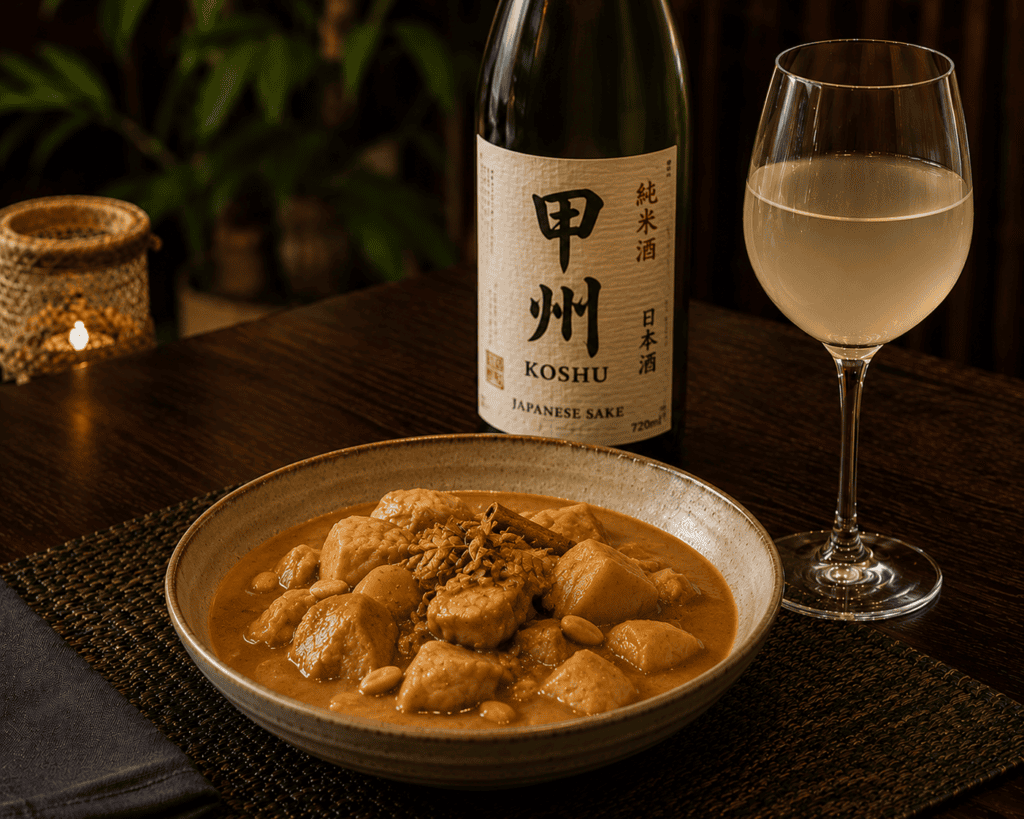
Sweet, mildly spiced, thick with cardamom, cinnamon and peanut. Pour: a full-bodied Junmai, or an aged Koshu if you have one. Why: the heat is low enough that you can pair on richness rather than defend against chili. Koshu’s caramel, soy and dried-fruit notes are a remarkable match for the warm spices. Serve gently warmed.
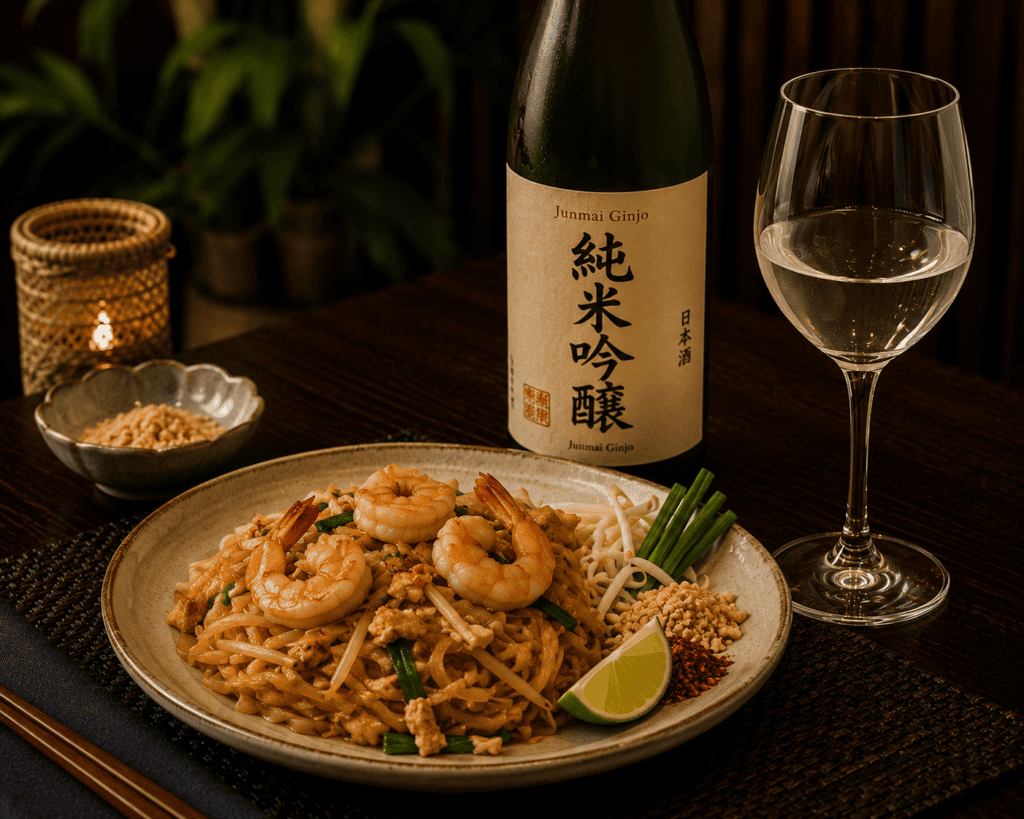
Tamarind sourness, palm sugar, egg, peanut, dried shrimp. Pour: Junmai Ginjo, or Nigori if the dish is on the sweeter side. Why: tamarind’s dark, sour-sweet profile needs fruit to answer it. A crisp, neutral sake will taste thin here.
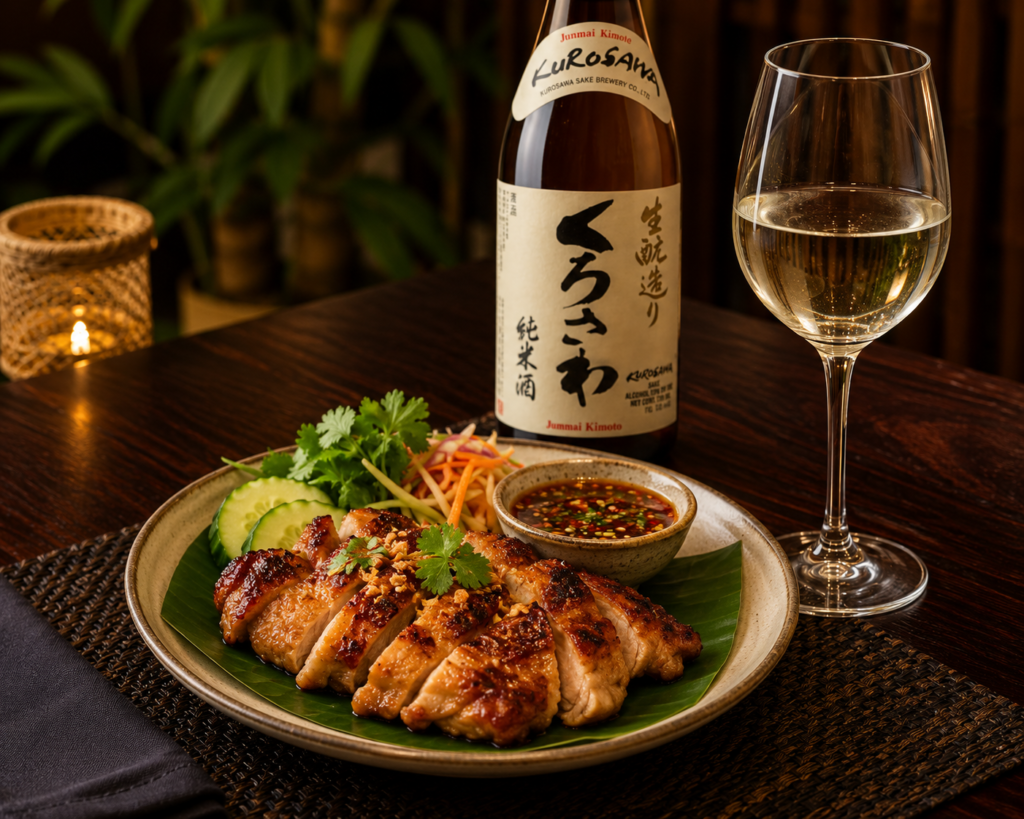
Pour: a robust Junmai or Kimoto, served warm at 40 °C (nuru-kan). Why: caramelised marinade and charcoal smoke want body and savoury depth, not delicacy. This is where warm sake earns its reputation, and where street food and premium sake meet on equal terms.
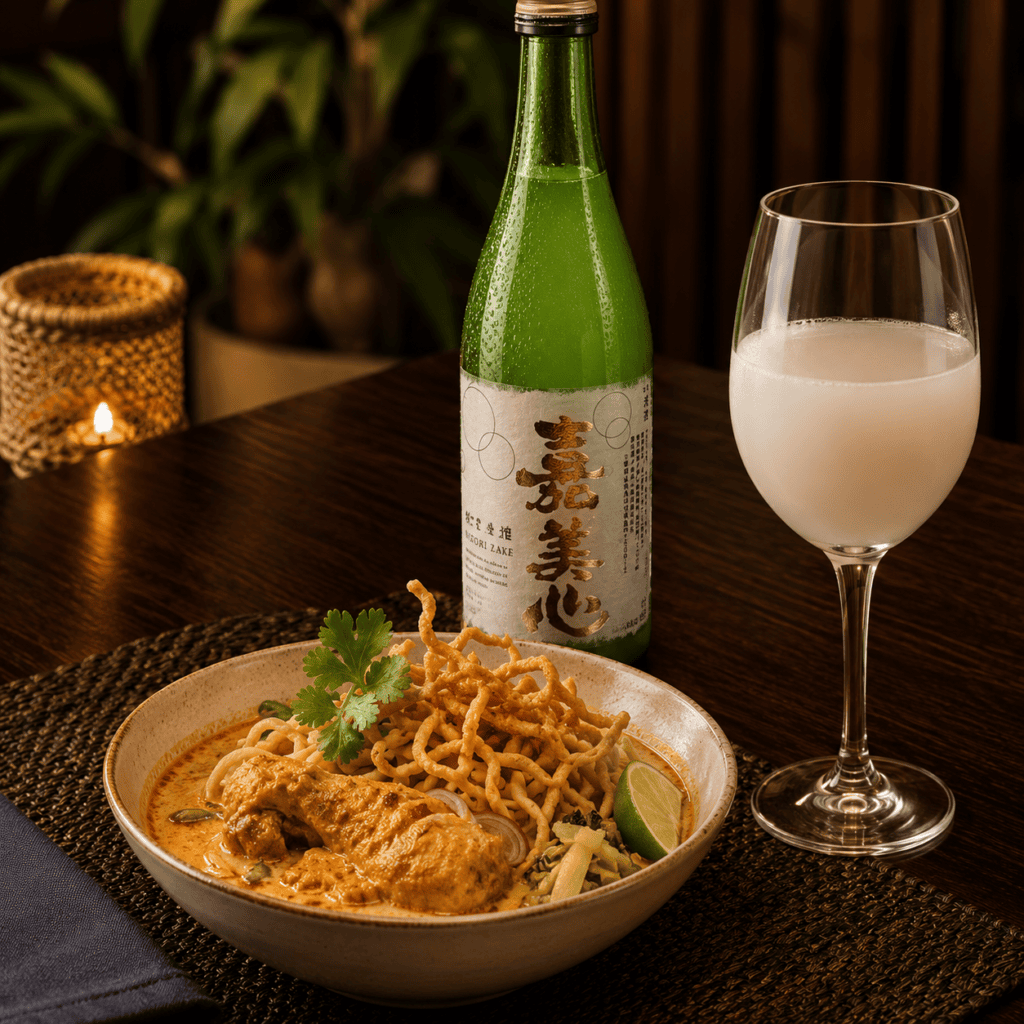
Coconut curry broth, soft and crisp noodles, pickled mustard greens, shallot, lime. Pour: sparkling sake. Why: the dish is rich, sour and spicy simultaneously; carbonation scrubs the fat while the low alcohol keeps the chili in check. A Nigori is the fallback.
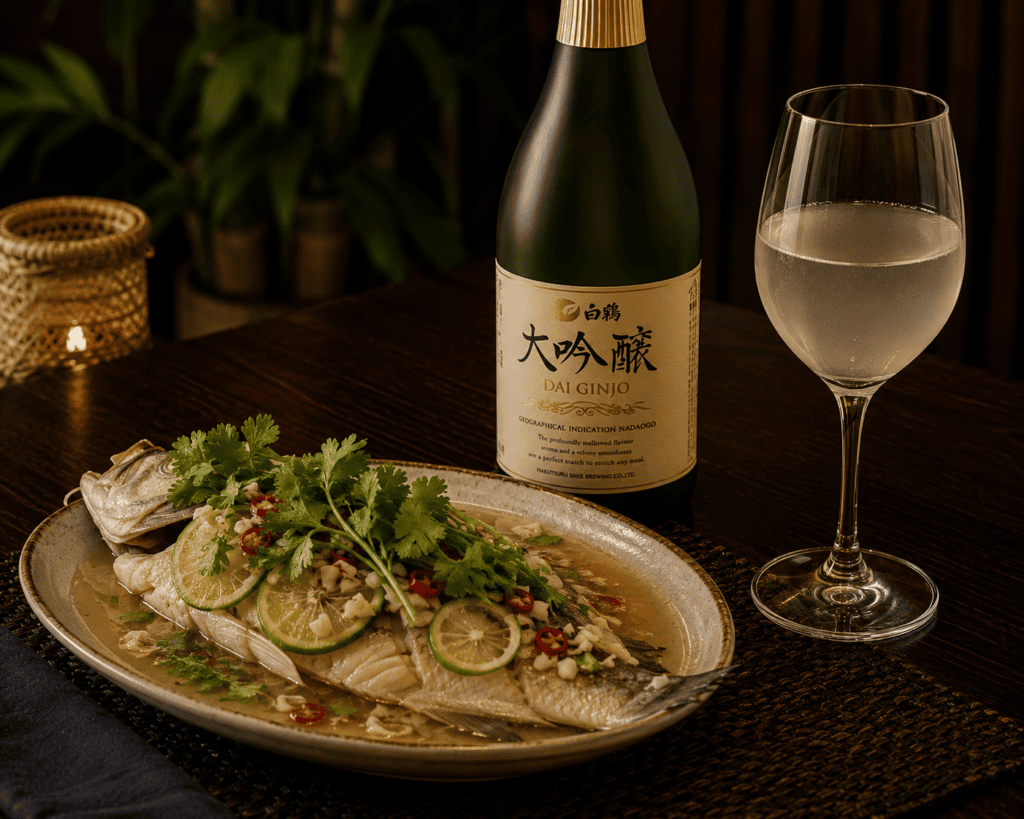
Pour: this is your Junmai Daiginjo moment — but only if the chili is moderate. Why: delicate white fish and a clean, silky, highly aromatic sake belong together. If the plate arrives buried in bird’s eye chili, step down to a Junmai Ginjo and save the Daiginjo for the next course.
Fermented shrimp paste at full intensity. Pour: Yamahai Junmai or Koshu, at room temperature or slightly warmed. Why: maximum umami against maximum umami. A light, chilled sake disappears entirely against kapi. This pairing surprises people more than any other in our classes.
Pour: sparkling sake or a crisp, lightly aromatic Junmai Ginjo, cold. Why: sake’s low iron content is the reason it does not turn metallic with shellfish, which is precisely where many white wines fail.
Pour: Nigori, or a genuinely sweet sake such as Kijoshu. Why: the classic dessert rule applies without modification — the drink must be sweeter than the dish, or it will taste sour and hollow. A dry Junmai here is a mistake, not a bold choice.
Here is the problem no international pairing guide addresses: Thai meals are not served in courses. Five or six dishes land at once and everyone eats across all of them. Pairing one sake to one dish is a Japanese or European model, and it does not survive contact with a Bangkok table.
What works instead is a two-bottle strategy.
Two bottles at two temperatures will cover almost any Thai menu. This is the approach we teach restaurant teams in our HORECA sessions, because it is also the easiest sake programme for a floor team to execute consistently.
Sake is the only major beverage category deliberately served across a 45-degree range, and temperature will change a pairing more than switching bottles will. Two rules matter most with Thai food:
| Japanese term | Temperature | Best for |
|---|---|---|
| Yuki-hie | 5 °C | Nigori and sparkling with the spiciest dishes |
| Hana-hie | 10 °C | Ginjo and Daiginjo, seafood, sour salads |
| Suzu-hie | 15 °C | Junmai with mild stir-fries |
| Hitohada-kan | 35 °C | Larb, herb-driven Isaan dishes |
| Nuru-kan | 40 °C | Grilled meats, nam prik, massaman |
| Jō-kan | 45 °C | Rich, fatty, deeply savoury dishes |
Reading about pairing gets you part of the way. Tasting the same Junmai at 8 °C and then at 40 °C alongside the same plate of larb is what makes the principle permanent.
At Wine & Spirit Academy, our sake programme runs across three levels, each with a certificate of completion and guided tastings led by certified sake educators:
See dates and book at our sake classes, or read our beginner’s guide to sake types and flavors first. Restaurant and hotel teams can also arrange on-site HORECA training.
Choose a sake with some residual sweetness, a soft texture and moderate alcohol, and serve it cold. Nigori is the most reliable option, followed by sparkling sake. Avoid high-alcohol Genshu and avoid warming the sake, as both intensify the sensation of chili heat.
Yes, and coconut-based Thai curries are among sake’s best partners. Pair green curry and other chili-forward curries with a chilled Nigori, whose creamy texture mirrors the coconut milk. For milder, sweeter curries such as massaman, a full-bodied Junmai or an aged Koshu served gently warmed works better.
In most cases, yes. Sake has no tannin to clash with chili, low acidity that lets the lime and tamarind in the dish lead, and a high amino acid content that amplifies the umami of fish sauce and shrimp paste. Aromatic off-dry white wines such as Riesling remain a strong alternative, but sake covers a wider range of Thai dishes.
Cold for anything spicy, sour or delicate; warm for grilled, fermented and richly savoury dishes. Cold suppresses chili heat while warmth releases umami and body. A good default at a shared Thai table is one chilled Junmai Ginjo plus one warmed Junmai.
https://wsa-bangkok.com/services/sake-classes/
Mail: wsafbscorporate@gmail.com
Phone: 0990168838

The most complete certified wine program in Bangkok is the

Short answer: WSET is the global reference for structured wine
In the heart of Bangkok’s century-old Nai Lert Park, something