By Wine & Spirit Academy (WSA Bangkok)
The short answer: all three are sparkling wines, but they are made differently. Champagne comes from one region of France, is made mainly from Chardonnay, Pinot Noir and Meunier, and gets its bubbles from a second fermentation in the bottle, followed by at least 15 months of ageing. Cava is Spain’s sparkling wine, made with the same bottle-fermented method but from local grapes (Macabeo, Xarel·lo, Parellada) and with a minimum of 9 months of ageing. Prosecco is Italian, made mainly from the Glera grape, and gets its bubbles in a large pressurised tank, which keeps it fresh, fruity and affordable. Champagne is toasty and complex, Cava is crisp and savoury, Prosecco is light and floral.
Every December, Bangkok’s hotel bars, rooftops and gift shops fill with bottles of all three, and the question is always the same: is Champagne really worth three times the price of a Prosecco? Is Cava just “cheap Champagne”? Why does an “Extra Dry” Prosecco taste sweeter than a “Brut”?
The answers are not a matter of taste or marketing. They are written in law. Each of these wines is a protected designation with its own list of permitted grapes, its own production method and its own minimum ageing. This guide walks through each one — grape varieties, method and legislation — then compares them head to head, decodes the sweetness labels, and explains how to serve and pair them in Bangkok.
| Champagne | Cava | Prosecco | |
|---|---|---|---|
| Country | France | Spain | Italy |
| Protected status | AOC Champagne (since 1936) | DO Cava | Prosecco DOC (since 2009); Conegliano Valdobbiadene and Asolo DOCG |
| Main area | Champagne region, north-east of Paris | Mostly Catalonia (Penedès), over 95% of production | Veneto and Friuli Venezia Giulia, north-east Italy |
| Main grapes | Chardonnay, Pinot Noir, Meunier | Macabeo, Xarel·lo, Parellada | Glera (minimum 85%) |
| Method | Traditional method: 2nd fermentation in the bottle | Traditional method: 2nd fermentation in the bottle | Tank (Charmat or Martinotti) method: 2nd fermentation in a pressurised tank |
| Minimum ageing | 15 months (non-vintage), 36 months (vintage) | 9 months (Guarda); 18 / 30 / 36 months for Reserva, Gran Reserva, Paraje Calificado | No long lees ageing required; released young |
| Bubbles | Fine, persistent, creamy | Fine, firm | Lighter, frothier |
| Typical aromas | Brioche, toast, citrus, green apple, almond | Citrus, green apple, herbs, almond, a savoury, earthy note | Pear, green apple, white flowers, melon |
| Acidity | High | Medium to high | Medium |
| Best drunk | Young or aged (vintage Champagne ages for decades) | Young; Reserva and Gran Reserva can age | Young and fresh, within 1–2 years |
| Price level | Highest | Low to medium | Low to medium |
| Choose it for | Celebrations, gifts, gastronomy | Value, aperitif, tapas, fried food | Aperitif, brunch, cocktails (Spritz, Bellini) |
Every sparkling wine starts as a still wine. The bubbles come from a second fermentation: sugar and yeast are added, the yeast eats the sugar, and the carbon dioxide it produces is trapped under pressure. The single most important difference between Champagne, Cava and Prosecco is where that second fermentation happens.
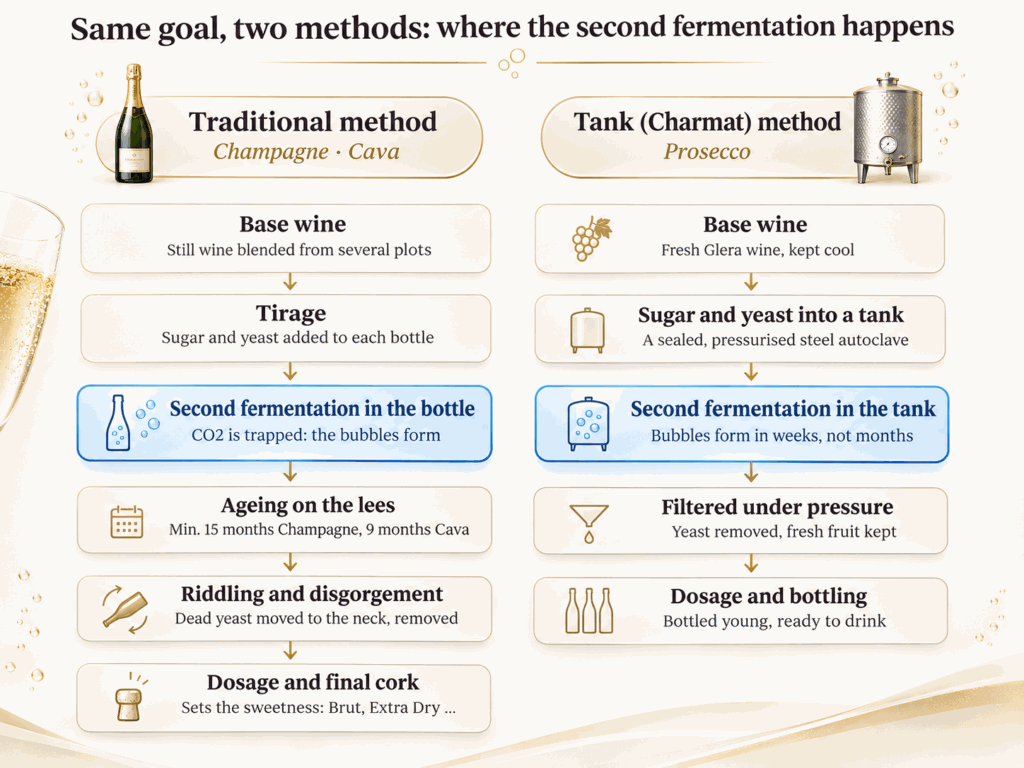
The traditional method (méthode traditionnelle, called méthode champenoise only in Champagne) runs the second fermentation inside each bottle. The wine then rests on the dead yeast cells, called lees, for months or years. This contact, known as autolysis, is what gives Champagne and Cava their aromas of brioche, toast and biscuit, and their fine, creamy bubbles. The yeast is then gathered in the neck by riddling and removed by disgorgement. It is slow, labour-intensive and expensive, which is the first reason Champagne costs what it does.
The tank method (called Charmat in France and Martinotti in Italy, after the Italian who patented it in 1895) runs the second fermentation in a large sealed steel tank. It takes weeks rather than months, the wine spends little time on the lees, and it is filtered and bottled under pressure. The result keeps the grape’s fresh fruit and flowers intact, which is exactly what Glera is valued for, and costs far less to produce.
Neither method is “better”. The traditional method builds complexity and ageing potential; the tank method preserves freshness and aromatics. A delicate, aromatic grape like Glera would lose its charm after three years on the lees; a high-acid Chardonnay from Champagne needs that time to become complete.
Two footnotes are useful for blind tasting: some Prosecco Superiore DOCG is made by refermentation in the bottle and left unfiltered (labelled sui lieviti, cloudy and dry), and other regions use the traditional method too, from French Crémant to Italy’s Franciacorta.
Seven grape varieties are authorised in Champagne, but three make up more than 99% of the vineyard:
| Grape | Share of vineyard | What it brings to the blend |
|---|---|---|
| Pinot Noir | About 38% | Body, structure, red fruit; dominant in the Montagne de Reims and Côte des Bar |
| Meunier | About 31% | Fruitiness, roundness, approachability when young; Vallée de la Marne |
| Chardonnay | About 30% | Finesse, citrus, freshness and long ageing potential; Côte des Blancs |
| Pinot Blanc, Pinot Gris, Arbane, Petit Meslier | Under 0.3% together | Heritage varieties, used by a handful of growers |
The blend gives the style its name on the label: Blanc de Blancs is 100% white grapes (Chardonnay), Blanc de Noirs is made only from black grapes (Pinot Noir and/or Meunier) pressed gently to keep the juice white, and Rosé is usually made by blending a little red wine into the white — a practice Champagne is one of the very few European appellations to allow.
Champagne is the reference for the traditional method. The key steps are fixed by its appellation rules:
Champagne was recognised as an AOC (Appellation d’Origine Contrôlée) by decree in 1936, but the fight to protect its name started almost a century earlier. The rules cover every step from vine to bottle:
Only wine that meets all of these rules can be called Champagne. A sparkling wine made the same way elsewhere in France is called Crémant; in the rest of the world, “Champagne-style” or “traditional method”.
High acidity, fine and persistent bubbles, citrus, green apple and white fruit, layered with brioche, toast and almond from the time on the lees. With age it develops honey, nuts and mushroom. For the region itself — the villages, the Grand Cru classification and the major houses — see our guide to French wine regions.
Cava’s identity comes from three native Catalan white grapes, which together supply around 85% of the harvest:
| Grape | What it brings to the blend |
|---|---|
| Macabeo (also called Viura) | Fruit, freshness and a light floral character; the most planted Cava grape |
| Xarel·lo | Body, structure and acidity; the backbone of long-aged Cavas, with herbal and earthy notes |
| Parellada | Finesse, delicate citrus and floral aromas; grown in the higher, cooler sites |
Other authorised varieties include Chardonnay and Malvasía (Subirat Parent) for whites, and Garnacha, Monastrell, Pinot Noir and Trepat for Cava Rosado. The local trio is what makes Cava taste different from Champagne even though the method is the same: less bread and brioche, more citrus, green herbs and a savoury, almost earthy note.
Cava uses exactly the same traditional method as Champagne: base wines are blended, sugar and yeast are added in the bottle, the second fermentation happens in the bottle, and the wine ages on its lees before riddling, disgorgement and dosage. The method arrived in Penedès in 1872, when Josep Raventós of Codorníu first applied bottle fermentation to the local grapes. The town of Sant Sadurní d’Anoia, west of Barcelona, is still the capital of Cava.
Two things keep Cava affordable: the warm, sunny climate ripens grapes easily and reliably, and much of the riddling is done mechanically in large crates (gyropalettes) rather than by hand.
Cava is a protected Designation of Origin (DO), and a rare one: it is defined by its method, not by a single region, so it can legally be made in several parts of Spain. Reforms that came into force in 2022 reorganised it around place and ageing.
Four zones:
Two ageing categories:
| Category | Minimum ageing on the lees | Extra requirements |
|---|---|---|
| Cava de Guarda | 9 months | Traceable from vineyard to bottle |
| Cava de Guarda Superior Reserva | 18 months (up from 15 under the old rules) | Organic grapes, hand harvest |
| Cava de Guarda Superior Gran Reserva | 30 months | Organic grapes, hand harvest; vintage on the label; Brut or drier only |
| Cava de Guarda Superior de Paraje Calificado | 36 months | A single qualified vineyard plot; the top of the pyramid |
Since 2025, all Guarda Superior Cavas must come from 100% organically farmed grapes. Some leading Penedès producers have also left the DO to create their own stricter labels, such as Corpinnat, so you will find excellent traditional-method Catalan sparkling wine that is not labelled Cava.
Crisp and dry, with lemon, green apple, quince and fresh herbs, a firm bead of bubbles and a savoury, mineral finish. Young Cava de Guarda is bright and simple; a Gran Reserva after 30 months on the lees gains toast, almond and depth that can rival Champagne at a fraction of the price.
Prosecco is made from at least 85% Glera, a white grape with large, loose bunches and delicate aromas of pear, apple and white flowers. The grape itself used to be called “Prosecco”. In 2009 Italy renamed it Glera, so that the word Prosecco now refers only to a protected place and cannot be used for wines made from the grape elsewhere in the world.
The remaining 15% may come from local varieties (Verdiso, Bianchetta Trevigiana, Perera) or international ones (Chardonnay, Pinot Bianco, Pinot Grigio, Pinot Nero). Prosecco Rosé, allowed only since 2020, must contain 85–90% Glera and 10–15% Pinot Nero (Pinot Noir).
Almost all Prosecco is made by the tank method, also called Charmat or Martinotti. The base wine goes into a large pressurised steel tank with sugar and yeast; the second fermentation happens there, then the wine is filtered and bottled under pressure. Because the wine spends little time on its lees, it keeps the fresh, primary fruit of Glera rather than developing bready aromas.
Prosecco comes in three levels of fizz:
Rosé Prosecco must spend at least 60 days in the tank for its second fermentation, and must show the vintage year (millesimato) on the label.
The same 2009 reform built a three-level quality pyramid:
| Level | Area | What sets it apart |
|---|---|---|
| Prosecco DOC | Nine provinces across Veneto and Friuli Venezia Giulia, mostly flat land and gentle foothills | The large majority of Prosecco; may add “Treviso” or “Trieste” to the label when made there |
| Asolo Prosecco DOCG | The Asolo hills, Treviso province | Lower yields, hillside vineyards |
| Conegliano Valdobbiadene Prosecco Superiore DOCG | The steep hills between Conegliano and Valdobbiadene, a UNESCO World Heritage Site since 2019 | Lower yields, more structure; includes Rive (single-village wines) and Cartizze, a tiny hill considered the grand cru of Prosecco |
DOCG stands for Denominazione di Origine Controllata e Garantita, Italy’s highest quality level. Prosecco Rosé exists only under the DOC; the two DOCGs do not make it.
Light to medium body, softer acidity than Champagne, frothy bubbles and clear aromas of green apple, pear, melon, honeysuckle and white flowers. It is made to be drunk young: within one to two years of the vintage, when the fruit is at its freshest.
All three wines use the same European sweetness scale, set by the dosage added just before corking. It is the most misunderstood part of any sparkling wine label, because the words do not mean what they seem to.
| Label term | Residual sugar (grams per litre) | What it tastes like |
|---|---|---|
| Brut Nature (Pas Dosé, Zero Dosage) | 0–3 g/L, no sugar added | Bone dry, very crisp |
| Extra Brut | 0–6 g/L | Very dry |
| Brut | Under 12 g/L | Dry: the most common style of Champagne and Cava |
| Extra Dry (Extra Sec) | 12–17 g/L | Off-dry, a touch of sweetness: a classic style for Prosecco |
| Dry (Sec) | 17–32 g/L | Noticeably sweet |
| Demi-Sec | 32–50 g/L | Sweet; good with desserts |
| Doux (Dolce) | Over 50 g/L | Very sweet, now rare |
The trap: “Extra Dry” is sweeter than “Brut”. This is why a bottle of Prosecco Extra Dry often tastes softer and fruitier than a Champagne Brut — part of the difference is the grape and the method, and part is simply more sugar.
For the Thai table, this matters more than people think. A touch of sweetness helps a sparkling wine stand up to chilli, while a Brut Nature can taste sharp and thin next to a spicy dish.
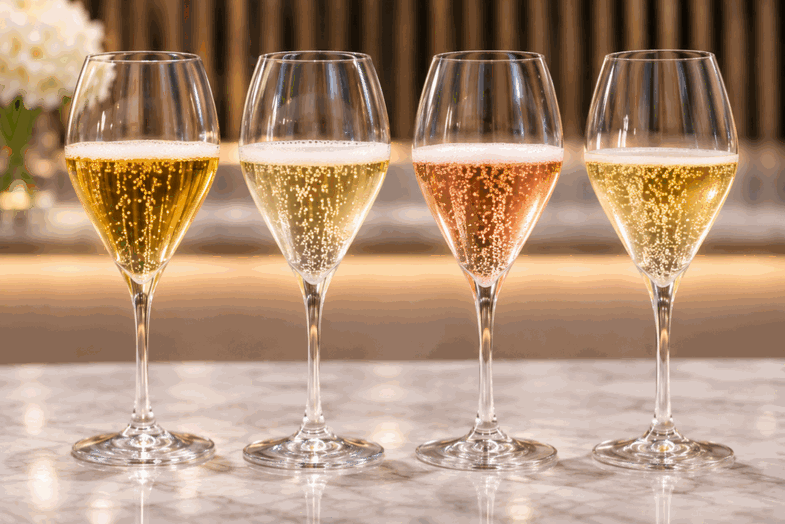
The biggest gap of the three. Champagne is made by the traditional method from Chardonnay, Pinot Noir and Meunier, aged at least 15 months on its lees, and tastes of citrus, brioche and toast with fine, persistent bubbles and high acidity. Prosecco is made by the tank method from Glera, released young, and tastes of pear, apple and white flowers with lighter, frothier bubbles. Champagne is built for complexity and can age; Prosecco is built for freshness and should be drunk young.
Which is sweeter? Usually Prosecco, because Extra Dry is a classic Prosecco style while Champagne is mostly Brut. Why is Champagne so expensive? Hand harvesting, a limited and costly vineyard area, the labour-intensive bottle method and long minimum ageing all add cost before the brand does.
Similar price, opposite philosophy. Cava follows the Champagne method, so it is drier, more structured and more savoury, with citrus and herbal notes and a firmer bead. Prosecco is softer, fruitier and more aromatic. Choose Cava with food, especially fried or salty dishes; choose Prosecco for an aperitif, a brunch or a Spritz.
The same method, different grapes and climate. Cava’s warm Mediterranean sun and its local grapes (Macabeo, Xarel·lo, Parellada) give riper citrus, herbs and an earthy, savoury character; Champagne’s cool northern climate and Chardonnay–Pinot Noir blend give higher acidity, more finesse and more bready complexity. Cava’s minimum ageing is shorter (9 months against 15), which is part of why it costs less. A Cava Gran Reserva, aged 30 months or more, is the closest Spanish answer to a Champagne, and one of the best-value bottles in the sparkling world.
Sparkling wine is one of the most food-friendly wines there is. Its acidity cuts fat, its bubbles scrub the palate clean, and its low tannin never clashes with chilli. The rule of thumb: the crisper and more complex the wine, the more delicate the dish; the fruitier the wine, the spicier the dish it can handle.
| Classic pairings | Thai dishes that work | Thai dishes to avoid | |
|---|---|---|---|
| Champagne Brut / Blanc de Blancs | Oysters, caviar, sushi, fried chicken, aged Comté or Parmesan, creamy dishes | Goong chae nam pla (raw prawns in fish sauce), tod mun pla, khanom jeeb, grilled seafood | Very hot curries and fiery salads: the chilli flattens the wine’s finesse |
| Champagne Rosé | Salmon, duck, red berries, Tuna | Moo yang (grilled pork), roast duck, khao man gai | Very sweet desserts |
| Cava | Tapas, jamón, croquettes, paella, anything fried | Kai jeow (Thai omelette), gai tod, spring rolls, satay, fried fish cakes | Rich coconut curries |
| Prosecco Extra Dry | Antipasti, light pasta, fruit, aperitif snacks | Miang kham, lightly spiced som tam, pomelo salad, fresh spring rolls | Heavy, rich meat dishes |
| Demi-Sec Champagne or sweet Prosecco | Fruit tarts, light desserts | Mango sticky rice, khanom krok | Savoury dishes |
The salty, fried, crispy side of Thai street food is where sparkling wine shines brightest — a cold Cava with gai tod is as good a pairing as any in Bangkok. For a full dish-by-dish guide across red, white and sparkling, read our Wine Pairing with Thai Food guide.
Temperature. In Bangkok’s heat, a sparkling wine warms up fast in the glass, and warm bubbles taste flat and alcoholic.
| Wine | Serve at | In practice |
|---|---|---|
| Prosecco and young Cava | 6–8 °C | Straight from the fridge, then into an ice bucket |
| Non-vintage Champagne, Cava Reserva | 8–10 °C | Out of the fridge 5 minutes before opening |
| Vintage Champagne, Cava Gran Reserva | 10–12 °C | Slightly warmer, so the aromas of age can open |
The fastest way to chill a bottle is an ice bucket filled with half ice, half water: about 20 minutes. Ice alone cools much more slowly. Keep the bottle in the bucket between pours.
Glass. Flutes keep bubbles, but a tulip or a white-wine glass shows the aromas far better, especially for Champagne. A dedicated glass such as the Lehmann Jamesse Grand Champagne is shaped for exactly that.
Opening. Point the bottle away from people at 45°, hold the cork firmly and turn the bottle, not the cork, until the cork eases out with a soft sigh rather than a pop. For a show at a party, sabrage — opening the bottle with a blade — is a classic; our Champagne saber is made for it.
Keeping an open bottle. A sparkling wine stopper keeps the bubbles for a day or two; the Champagne saver with air pump adds pressure back into the bottle.
Buying in Bangkok. Heat damages sparkling wine faster than still wine. Buy from shops that store bottles in a cool, air-conditioned room, never from a sunny shelf, and avoid bottles standing upright for months. For a special gift, our shop carries Dom Pérignon 2008 and 2017, two very different vintages of the same prestige Champagne — a perfect pair for anyone curious about how vintage changes a wine. A wine class gift voucher is the alternative for someone who would rather taste and learn.
Reading about autolysis is one thing; tasting a non-vintage Champagne next to a Blanc de Blancs and a rosé, and feeling the difference in the bubbles, is what makes it stick.
French Premium Class: Champagne — 3 hours, ฿6,500. Our masterclass dedicated to the region: its history, terroir and styles, with guided tasting, food pairing and expert commentary. The most direct way to understand everything in this article in a single session.
Celebrating as a group? The Champagne class can also be booked as a private French wine masterclass for teams, friends or a year-end party.
Going further with FSS. The Foundations of Sommelier Skills program builds the structured tasting method and grape knowledge behind any sparkling wine:
| Level | Duration | Price | Best for |
|---|---|---|---|
| FSS Basic | 1 day | ฿8,500 | Your first certificate: viticulture, main grape varieties, tasting method |
| FSS Intermediate | 2 days | ฿16,000 | French appellations and label law |
| FSS Advanced | 3 days | ฿24,000 | Blind tasting, service temperature, glassware, observed table service |
| Essentials of Sommelier Skills | 14 days + exam | ฿109,000 | The complete sommelier career pathway, with a supervised venue placement |
For hotels and restaurants. Teams that sell a lot of bubbles over the festive season can book on-site HORECA training, including a dedicated sparkling wine program.
Curious about the countries behind Cava and Prosecco? Our Spanish and Italian Premium Masterclasses (฿5,500 each) explore their regions and terroirs.
Champagne (France) and Cava (Spain) are made by the traditional method, with the second fermentation in the bottle; Prosecco (Italy) is made by the tank method. Champagne uses Chardonnay, Pinot Noir and Meunier and ages at least 15 months; Cava uses Macabeo, Xarel·lo and Parellada and ages at least 9 months; Prosecco uses at least 85% Glera and is released young.
Yes. Cava uses the same traditional method, with the second fermentation in the bottle and ageing on the lees. The differences are the grapes, the warmer climate and the shorter minimum ageing.
Mainly Chardonnay, Pinot Noir and Meunier, which make up more than 99% of the vineyard. Four heritage varieties are also allowed: Pinot Blanc, Pinot Gris, Arbane and Petit Meslier.
At least 85% Glera, a white grape that was itself called Prosecco until 2009. Prosecco Rosé adds 10–15% Pinot Noir.
Mainly the Catalan trio Macabeo, Xarel·lo and Parellada. Chardonnay, Malvasía, and for rosé Garnacha, Monastrell, Pinot Noir and Trepat are also permitted.
Prosecco usually tastes sweeter: it is often bottled as Extra Dry (12–17 g/L of sugar), while most Champagne is Brut (under 12 g/L). Its fruity Glera aromas also make it seem sweeter.
Yes. On a sparkling wine label, Extra Dry contains more sugar than Brut. Brut Nature and Extra Brut are the driest styles.
Hand harvesting, limited vineyard land, the labour-intensive bottle method and a legal minimum of 15 months of ageing (36 for vintage) all cost more than tank fermentation and a quick release.
DOCG is Italy’s highest quality level. For Prosecco it covers two hillside areas, Conegliano Valdobbiadene Prosecco Superiore and Asolo Prosecco, with lower yields than Prosecco DOC.
Wine & Spirit Academy runs a 3-hour French Premium Class dedicated to Champagne (฿6,500), as well as the four-level FSS sommelier program, from a one-day FSS Basic to the 14-day Essentials of Sommelier Skills.
Champagne, Cava and Prosecco are not better or worse versions of the same drink. They are three different answers, written into three different laws: one built on time and complexity, one on value and character, one on freshness and fruit. The best way to choose is to taste them side by side, with someone to show you what to look for.
→ One session: book the French Premium Class: Champagne (3 hours, ฿6,500), or the private version for your year-end party.
→ A qualification: start with FSS Basic (1 day, ฿8,500) or see the full FSS sommelier program.
→ A gift: Dom Pérignon 2008, a Champagne saber or a wine class gift voucher from our wine & accessories shop.
Questions? Call 099-016-8838 (Mon–Fri, 9:00 am–8:00 pm) or message us on LINE. Want to keep learning? Read Cabernet Sauvignon vs Merlot vs Pinot Noir or French Wine Regions Explained.

By Wine & Spirit Academy (WSA Bangkok) The short answer:
By Wine & Spirit Academy (WSA Bangkok) The short answer: