Most people who say they find French wine intimidating are not struggling with the wine. They are struggling with the label.
A bottle from California says Cabernet Sauvignon on the front. A bottle from France says Pauillac — a village of 5,000 people — and assumes you already know that Pauillac means Cabernet Sauvignon. That single convention is responsible for almost all the confusion, and once you understand it, French wine stops being a memory test and starts being a map.
This guide walks through the five regions that account for the overwhelming majority of the French wine you will actually encounter in Bangkok: Bordeaux, Burgundy, Champagne, the Rhône Valley and the Loire Valley. For each one, you will get the grapes, the logic of the place, and the one idea that makes the rest fall into line.
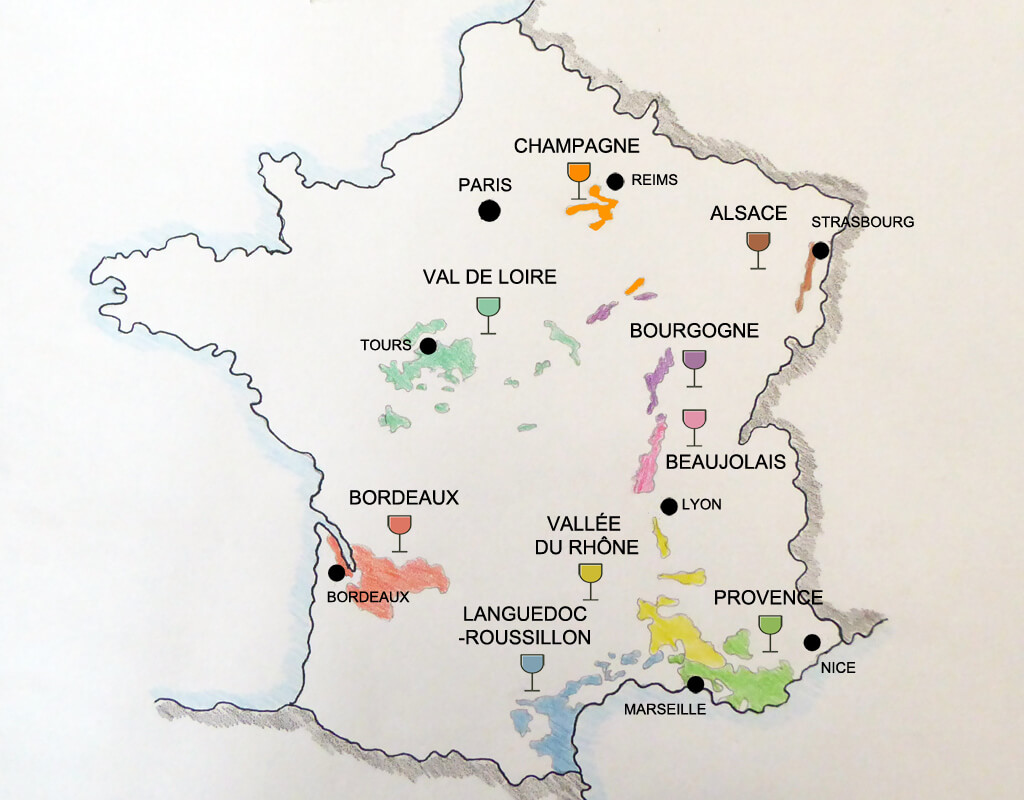
French wine law is built on appellations — protected place names. An appellation does not just say where the wine comes from. It dictates which grapes may be planted, how much may be harvested per hectare, and often how the wine must be made.
So when a label says Chablis, it is telling you: Chardonnay, grown in a specific cool corner of northern Burgundy, at yields capped by law. The grape is not printed because within that appellation it could not have been anything else.
This is why learning French wine means learning places, not varieties. It is more work upfront and far more useful afterwards, because place tells you about climate, soil and tradition all at once — three things a grape name alone can never convey.
Keep that in mind as you read the five regions below.
Grapes: Cabernet Sauvignon, Merlot, Cabernet Franc, Petit Verdot (red); Sauvignon Blanc, Sémillon (white and sweet)
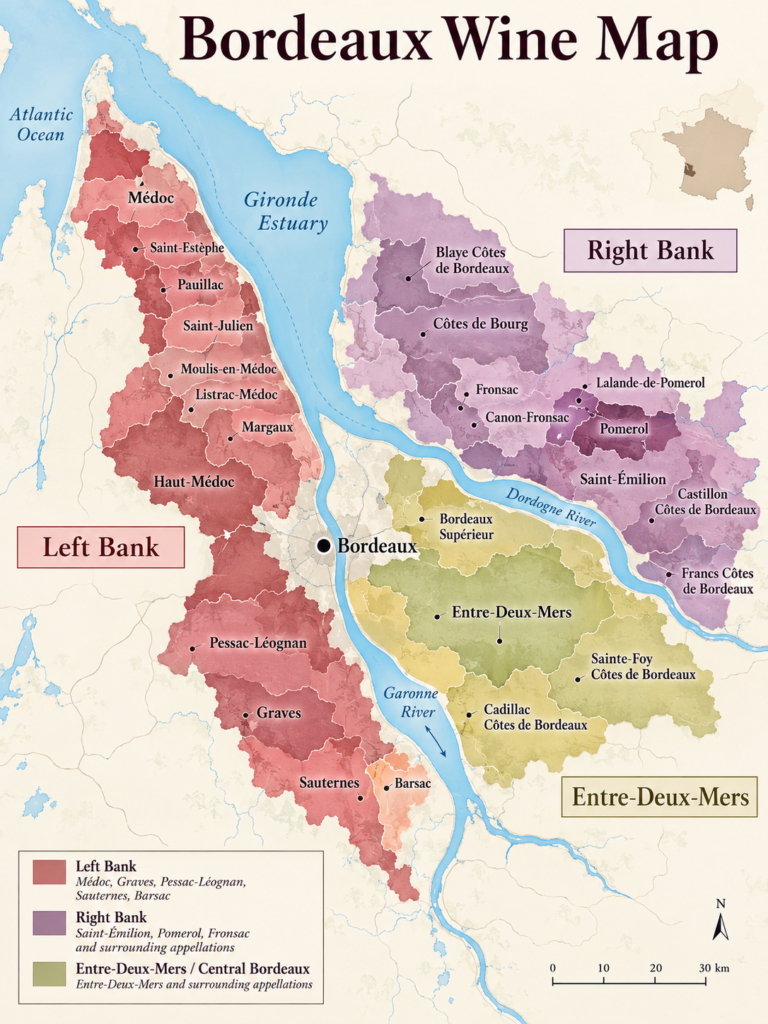
Bordeaux sits on the Atlantic coast, split by the Gironde estuary into two banks — and that split is the whole structure of the region.
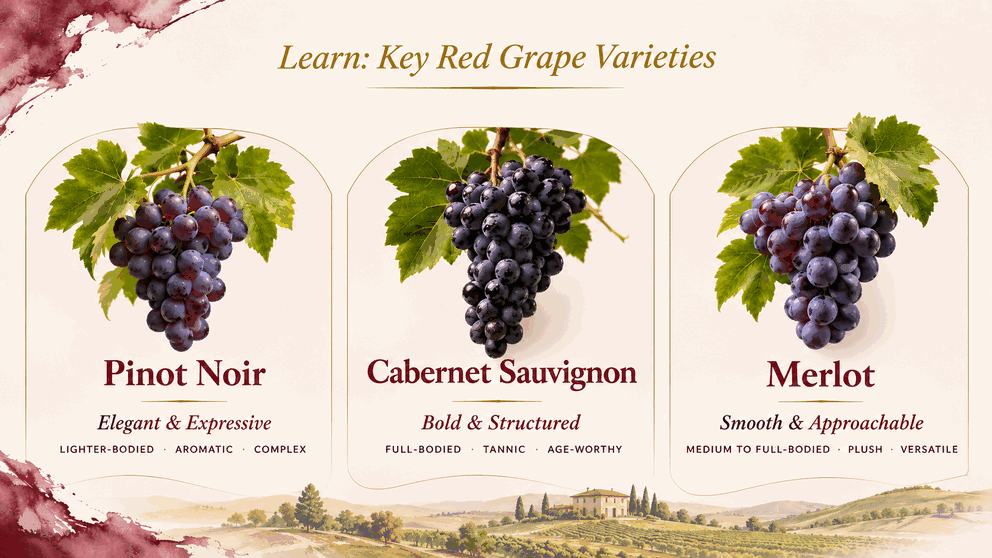
The Left Bank (Médoc, Pessac-Léognan) has deep gravel soils that drain well and store heat. Cabernet Sauvignon ripens there, and Cabernet Sauvignon leads the blend. These wines are firm, structured, built on tannin and cassis, and they reward patience. Pauillac, Margaux, Saint-Julien and Saint-Estèphe are all Left Bank communes.
The Right Bank (Saint-Émilion, Pomerol) has clay and limestone, which stays cooler and holds water. Merlot thrives there and dominates the blend. These wines are rounder, plusher, more immediately generous.
The blending itself is the point. A Bordeaux château does not make one wine from one grape — it grows several varieties that ripen at different times, then assembles them each year to produce a consistent house style despite variable weather. That is a fundamentally different philosophy from Burgundy, and understanding it explains almost everything about how the two regions taste.
What Bordeaux teaches your palate: tannin structure, the effect of oak ageing, and how a wine’s shape changes over a decade in bottle.
Worth knowing: Bordeaux has its own historical ranking — the 1855 Classification — and in September 2026 it received a second one when the MICHELIN Guide awarded its first Bordeaux Grappes to 62 châteaux.
Want to learn more about Bordeaux: https://wsa-bangkok.com/product/french-premium-class-bordeaux/
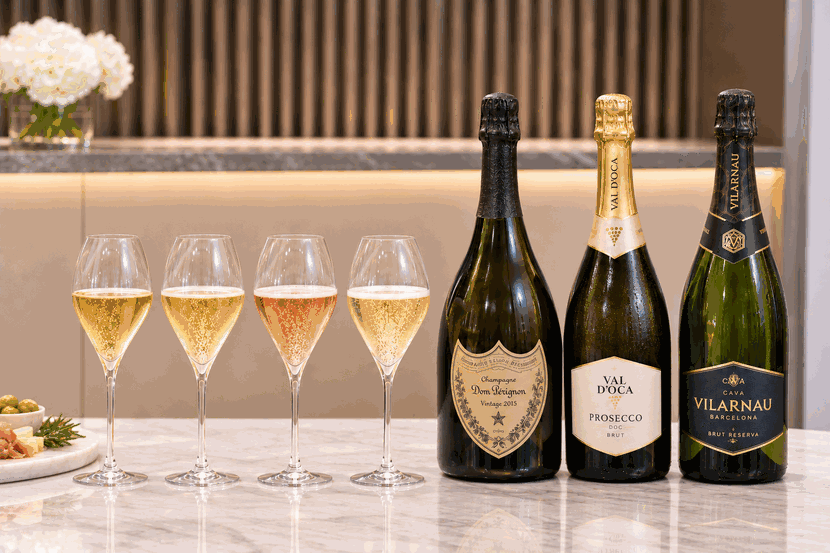
Grapes: Pinot Noir (red), Chardonnay (white). Almost nothing else.
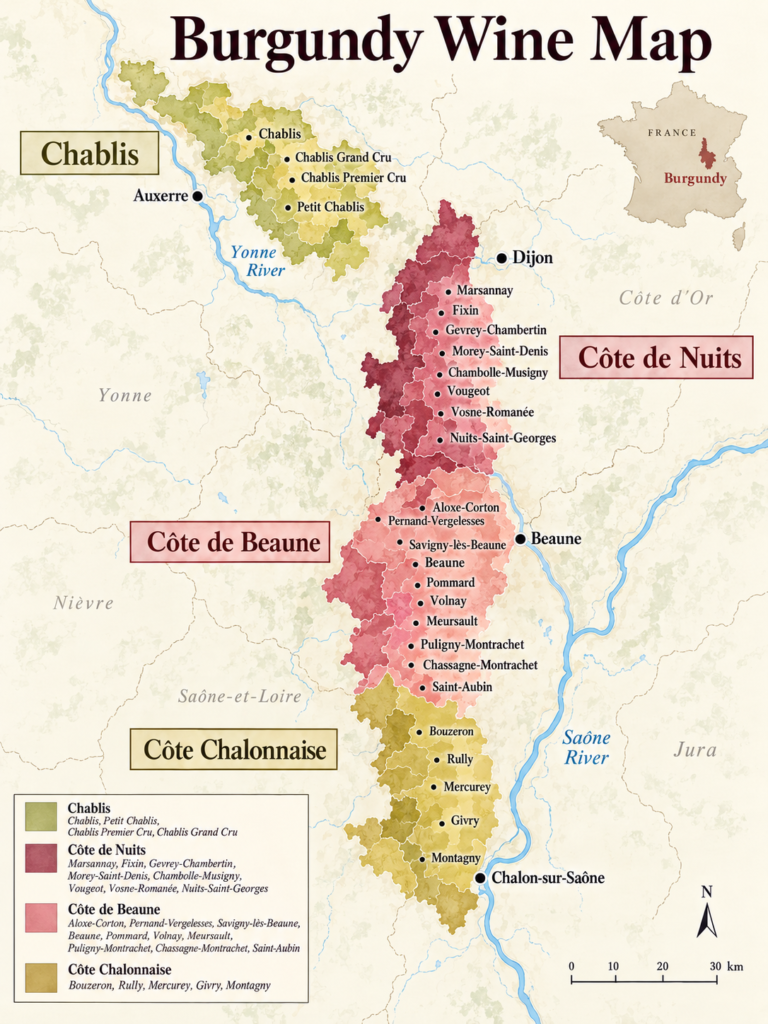
If Bordeaux is about blending many grapes into one wine, Burgundy is the opposite: one grape, split across hundreds of individual plots.
A narrow strip of hillside running south from Dijon has been mapped, plot by plot, since medieval monks first catalogued which patches of vineyard consistently produced better wine. That mapping became a four-level pyramid:
| Level | What the label says | Share of production |
|---|---|---|
| Regional | Bourgogne | Largest volume, entry point |
| Village | Meursault, Gevrey-Chambertin | Named village |
| Premier Cru | Meursault 1er Cru Charmes | Named plot within a village |
| Grand Cru | Montrachet, Chambertin | The plot alone — no village needed |
The counterintuitive part: the more specific the name, the higher the level. A label reading simply “Chambertin” outranks one reading “Gevrey-Chambertin,” because the first is a Grand Cru and the second is the village that borrowed its name.
Burgundy estates are small — often family holdings of a few hectares scattered across many appellations. This is why Burgundy is expensive and why allocations to Thailand are tiny.
What Burgundy teaches your palate: nuance. Two wines from the same grape, same producer, same year, plots 200 metres apart — and they taste different. Nothing trains a taster faster.
If you want to go deeper: we covered the Michelin Grappes and the full Burgundy list when the award launched in July 2026.
Want to learn more about Burgundy: https://wsa-bangkok.com/product/french-premium-class-burgundy/
Grapes: Chardonnay, Pinot Noir, Pinot Meunier
Champagne is France’s northernmost major wine region, and it is cold. Grapes there struggle to ripen fully, producing thin, sharp base wines that would be difficult to enjoy on their own.
That apparent weakness is the foundation of everything. High acidity is exactly what a great sparkling wine needs, and the traditional method — a second fermentation inside the sealed bottle, followed by years of ageing on the spent yeast — converts it into something else entirely. Those years on the lees are where Champagne gets its brioche, toast and almond character. No shortcut produces it.
Three terms decode most Champagne labels:
A fourth term is worth learning: Grower Champagne (look for the small letters RM on the label). These come from producers who grow their own grapes rather than buying them, and they have become the most interesting category in the region.
What Champagne teaches your palate: the role of acidity as a structural element, and how autolytic character — that bready, savoury depth — develops over time.
Want to learn more about Champagne: https://wsa-bangkok.com/product/french-premium-class-champagne/
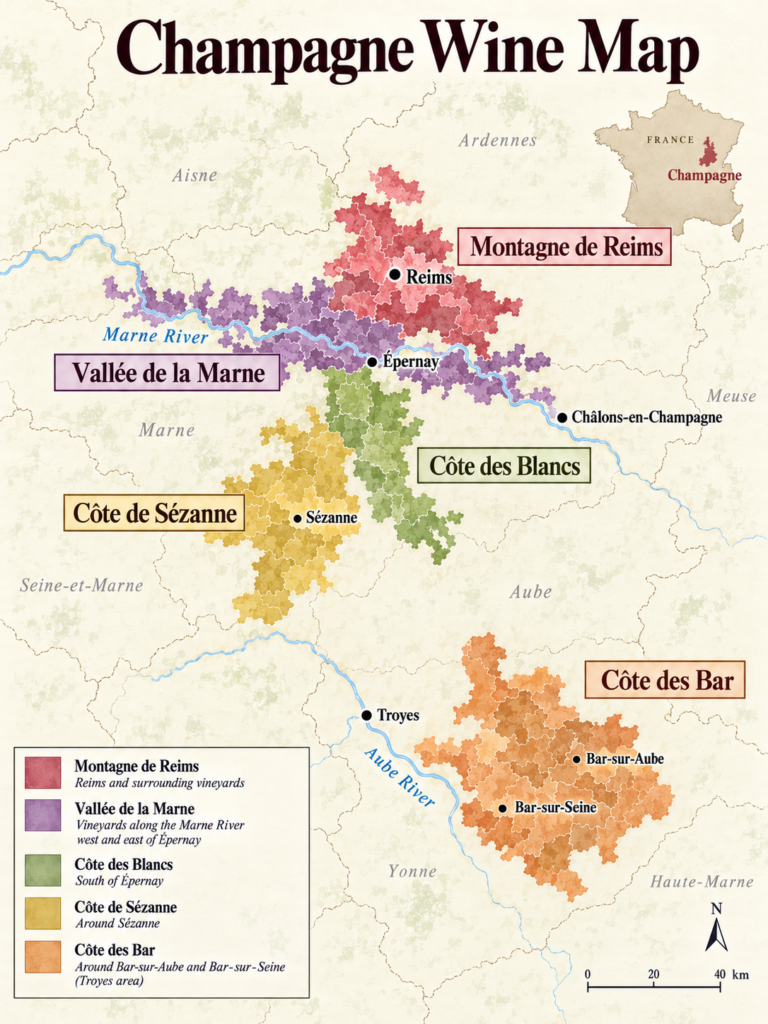
Grapes: Syrah, Viognier, Marsanne, Roussanne (north); Grenache, Syrah, Mourvèdre and a dozen others (south)
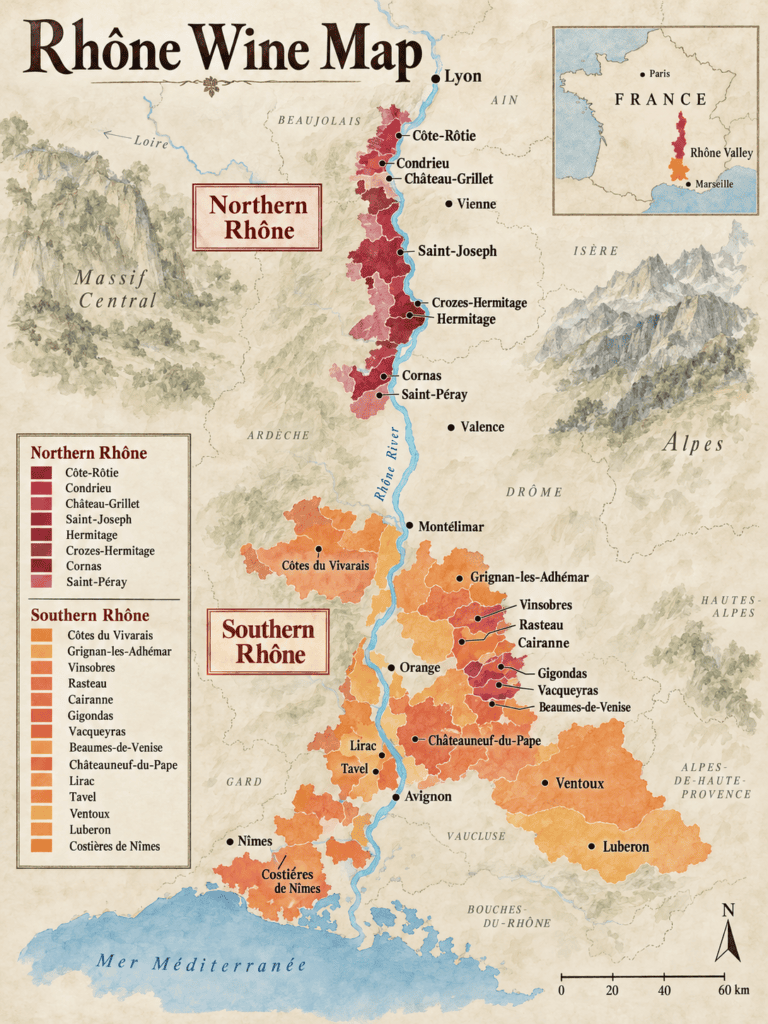
The Rhône is the most commonly misunderstood of the five, because “Rhône” describes two places that have very little in common beyond a river.
The Northern Rhône is small, steep and cool. Vineyards cling to terraced granite slopes above the river. The only red grape permitted is Syrah, and it produces wines that are peppery, floral and savoury rather than jammy — Côte-Rôtie, Hermitage, Cornas. The white grapes, Viognier and Marsanne, are equally distinctive.
The Southern Rhône is wide, flat, hot and Mediterranean. Here wines are blends, usually led by Grenache and supported by Syrah and Mourvèdre. Châteauneuf-du-Pape permits thirteen varieties. The wines are riper, warmer and higher in alcohol.
If you have ever been told you “don’t like Syrah” after a hot-climate example, a Northern Rhône bottle will likely change your mind. Same grape, completely different proposition.
What the Rhône teaches your palate: how dramatically climate reshapes a single variety, and how blending works in a warm climate as opposed to Bordeaux’s maritime one.
A Bangkok note: Southern Rhône reds are among the most food-friendly wines for Thai cuisine. Their ripe fruit and soft tannin handle chilli heat far better than a tannic Left Bank Bordeaux, which turns metallic against capsaicin.
Want to learn more about Rhone Valley: https://wsa-bangkok.com/product/french-premium-class-rhone-valley/
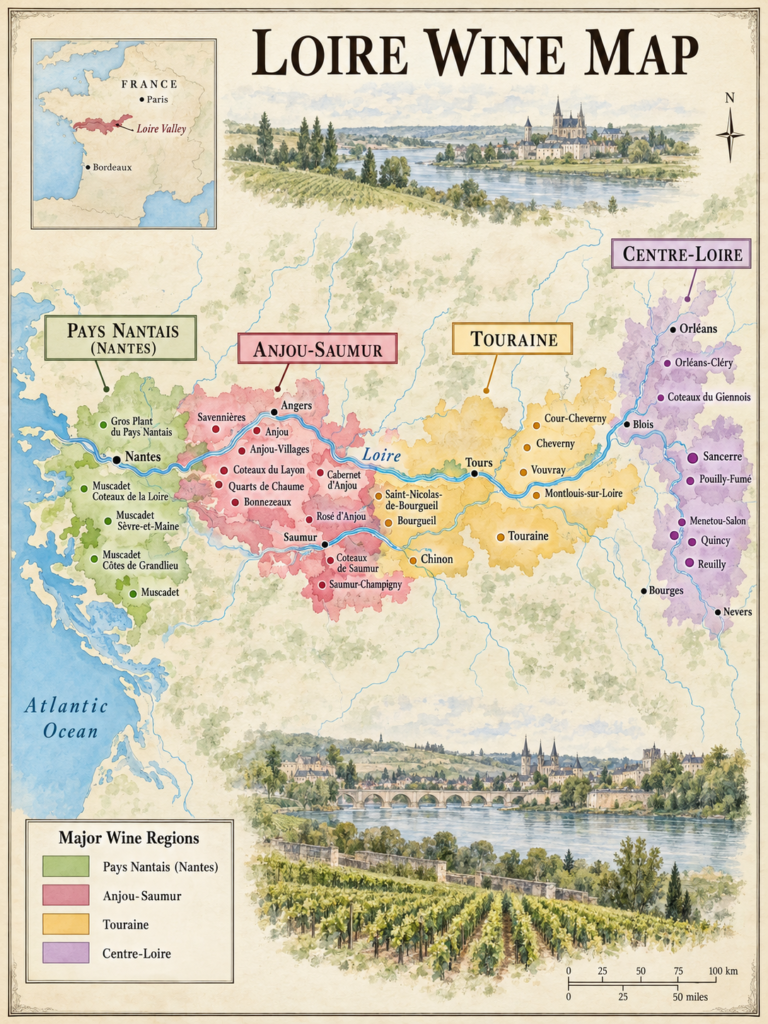
Grapes: Sauvignon Blanc, Chenin Blanc, Melon de Bourgogne, Cabernet Franc, Gamay, Pinot Noir
The Loire follows France’s longest river for roughly 1,000 kilometres, and the wines change completely as you travel it. Think of it as four regions in sequence:
The Loire is the region most often skipped by new students, and that is a mistake for two reasons. First, it delivers more quality per baht than anywhere else in France. Second, its high-acid, low-alcohol, lightly-oaked style is genuinely well suited to Bangkok’s climate and to Thai food.
What the Loire teaches your palate: how to taste without the distraction of oak or high alcohol. Stripped back, these wines show acidity and fruit purity more clearly than any other French region.
Want to learn more about Loire Valley: https://wsa-bangkok.com/product/french-premium-class-loire-valley/
| Region | Climate | Red logic | White logic | Learn it for |
|---|---|---|---|---|
| Bordeaux | Maritime | Cabernet/Merlot blends | Sauvignon/Sémillon | Tannin and structure |
| Burgundy | Continental | Pinot Noir, single variety | Chardonnay, single variety | Terroir and nuance |
| Champagne | Cool northern | — | Blended, traditional method | Acidity and ageing |
| Rhône | Continental (N) / Mediterranean (S) | Syrah (N), Grenache blends (S) | Viognier, Marsanne | Climate and ripeness |
| Loire | Cool to moderate | Cabernet Franc | Chenin, Sauvignon, Melon | Purity and value |
Most people start with Burgundy because it has the most prestige. That is the hardest possible entry point.
A better sequence, built on how quickly each region’s logic becomes visible in the glass:
1. Loire. Simple varietal wines with minimal oak. You learn to identify acidity, fruit and body without interference.
2. Bordeaux. Now add tannin, oak and blending. The Left Bank / Right Bank contrast is easy to taste side by side and gives you a structural vocabulary.
3. Rhône. Same grape, two climates. This is where you stop thinking in grape names and start thinking in growing conditions.
4. Champagne. Add a production method as a variable. You now have climate, grape and process all in play.
5. Burgundy. Last, deliberately. Burgundy’s differences are the most subtle in French wine, and you need the three previous regions’ worth of calibration before those differences register as anything other than noise.
Serving red wine too warm. “Room temperature” is a European convention that assumed a 16–18°C room. A Bordeaux served at 28°C tastes alcoholic and flat. Fifteen minutes in the fridge before pouring transforms it.
Storing bottles in a kitchen cupboard. Bangkok’s ambient heat ages wine quickly and unpredictably. Anything you intend to keep beyond a few weeks needs a wine fridge — not a favour to the wine, a requirement.
Matching Thai food by colour rather than structure. A tannic Left Bank Bordeaux against a som tam is genuinely unpleasant: chilli amplifies tannin and alcohol. Off-dry Chenin from the Loire, Southern Rhône Grenache, and Champagne all work far better. Structure matters more than the red/white distinction.
Reading about wine gets you to a point. Past that point you need bottles in front of you, side by side, with someone explaining what you are tasting — because the differences between a Left Bank and a Right Bank Bordeaux, or between a Northern and Southern Rhône Syrah, exist in the glass and nowhere else.
At Wine & Spirit Academy Bangkok, founded by a French sommelier, two programmes cover exactly the ground in this article.
A series of three-hour sessions, each dedicated to a single region, with guided tasting and food pairing. This is the right choice if you want to go deep on Bordeaux or Burgundy specifically, or if you would rather build your knowledge gradually, one evening at a time.
See the French Premium Class schedule →
The FSS Intermediate level is built around the classic French regions covered here: Bordeaux, Burgundy, Champagne, the Rhône Valley, the Loire and Alsace. Over two days you work through 16 wines in structured, progressively more demanding blind tasting, alongside professional service technique — decanting, glassware selection and correct service.
This is the right choice if you want the complete French map in one structured programme rather than region by region, or if you work in hospitality and need service skills alongside the tasting knowledge.
See the FSS Intermediate course details →
Not sure which fits? Call 099-016-8838 and we will talk it through.
What is the difference between Bordeaux and Burgundy? Bordeaux blends several grape varieties — principally Cabernet Sauvignon and Merlot — to produce a consistent house style from large estates. Burgundy uses a single variety per wine, Pinot Noir or Chardonnay, grown on small individually-named plots, so differences between wines come from the land rather than the blend.
Why don’t French wine labels show the grape variety? Because French appellation law already specifies which grapes may be grown in each place. The place name therefore implies the variety. Some regions, notably Alsace and parts of the Loire, do print the grape.
Which French wine region is best for a beginner? The Loire Valley. Its wines are typically single-variety, low in oak and moderate in alcohol, which makes the fundamentals — acidity, fruit, body — easier to identify than in more complex regions.
What does Grand Cru actually mean? It designates the highest classified vineyard sites, but the criteria differ by region. In Burgundy it refers to specific named plots. In Alsace it works similarly. In Saint-Émilion it forms part of a separate classification with its own rules. It is not a single France-wide standard.
Which French wines work best with Thai food? Wines with high acidity and low tannin generally perform best against chilli, lime and fish sauce. Off-dry Chenin Blanc from the Loire, Champagne, and Southern Rhône Grenache blends are reliable starting points. Tannic Left Bank Bordeaux is the most common mismatch.
Do I need prior experience to take a French wine class in Bangkok? No. The French Premium Class is open to anyone with an interest, and the FSS Intermediate level is structured so that motivated beginners can follow it, though prior tasting experience helps.
Is there a certification for French wine knowledge? Several international bodies certify wine knowledge, and the right one depends on whether you are studying for personal interest or for a hospitality career. We compared the main options in our guide to sommelier certifications available in Bangkok.
You do not need to learn all five at once. Pick the one that matches what you already drink, taste four or five bottles from it attentively, and the structure of the place will start to make sense. Then move to the next.
France has been organising its vineyards this way for eight centuries. The logic is there — it just has to be shown to you once. More information via Line OA:

By Wine & Spirit Academy (WSA Bangkok) The short answer:
By Wine & Spirit Academy (WSA Bangkok) The short answer:
By Wine & Spirit Academy (WSA Bangkok) The short answer: